

The American agave is one of those plants that adapts so well to living almost anywhere that it can easily become commonplace. But its widespread use doesn't make it any less beautiful; in fact, it's currently widely planted in xeriscapes, that is, gardens where plants thrive solely on rainwater, provided they aren't considered invasive.
Yes, unfortunately, it's a species of agave that's prohibited in many countries. For this reason, we're going to tell you everything about it so you'll know how to identify it whenever you have doubts.
What are their characteristics?
Agave americana is the scientific name of a species native to Mexico and the southern United States that has naturalized in South America, Spain, Asia, India, Australia, and New Caledonia. It was described by Carl Linnaeus and published in Species Plantarum in 1753, and is commonly known as agave, maguey, or yellow agave.
It is characterized by its succulent, spiny leaves that grow in a spiral pattern . These leaves can reach up to 2 meters in length and 25 cm in width, are lanceolate, and come in a variety of colors: bluish-white, grayish-white, green, or variegated (green and yellow). As they mature, a stem develops, acting as a "false trunk," which typically measures up to 30 cm in height.
It flowers only once at the end of its life , which is known as being a monocarpic plant. When this happens, an inflorescence about ten meters tall and 10 cm in diameter sprouts from the center, at the top of which emerge the small flowers arranged in open panicles. Each flower measures about 5-10 cm. The fruit is a trigonous, elongated capsule containing flat, black seeds. Before dying, it produces a large number of offshoots from its root.
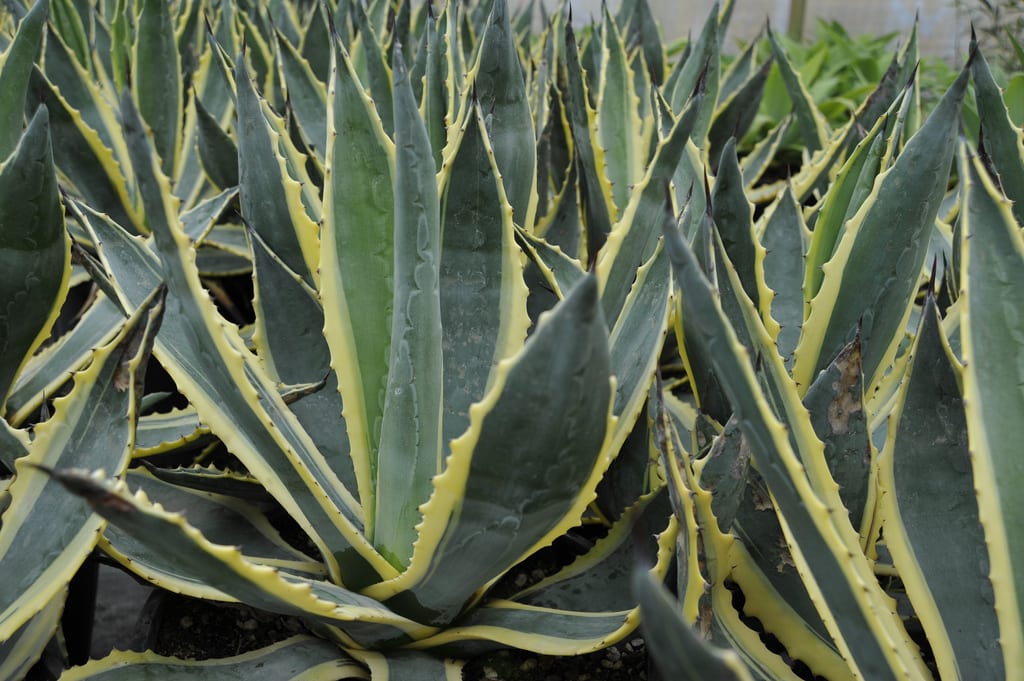
Agave Americana f Variegata
Image from Flickr / Megan Hansen
Does it have any use?
In those countries where it has naturalized, the truth is that its possession is prohibited in the vast majority of cases—including Spain—but in the rest of the world it is used as an ornamental plant , as well as for producing mezcal , a liquor made from the sugar-rich juice extracted from the sap of the flower stalk. Furthermore, in Central America it is also used therapeutically : the sap as a poultice; ingested to treat diarrhea, constipation, indigestion, jaundice, and as a laxative; and an infusion of the leaves as a purgative.
Finally, we cannot forget that the textile fiber from its leaves is used to produce rope, nets and other similar objects , this being a very resistant material.
Table of Contents