

Some cacti, despite their slow growth, are highly sought after. Whenever they go on sale, which isn't often, sellers often run out of stock within hours. This is the case with Ariocarpus retusus.
It doesn't have a typical shape for a cactus, but perhaps that's why, or because of the beautiful flower it produces, it's hard to find it missing from any collection. Are we familiar with it?
Ariocarpus retusus is the scientific name of a species native to Coahuila, Nuevo León, Tamaulipas and San Luis Potosí (Mexico) that was described by Michael Joseph François Scheidweiler and published in Bulletin de l'Academie Royale des Sciences et Belles-lettres de Bruxelles in 1838.
It is characterized by its somewhat unusual body: it has clustered, divergent tubers with pointed tips, greenish-gray in color, approximately 30 cm wide by 25 cm high . The areoles are located at the tips of the tubers. The flowers are about 3-5 cm in diameter and are light yellow, white, cream, or, more rarely, have red stripes down the center. The fruit is elongated and measures about 2,5 cm.
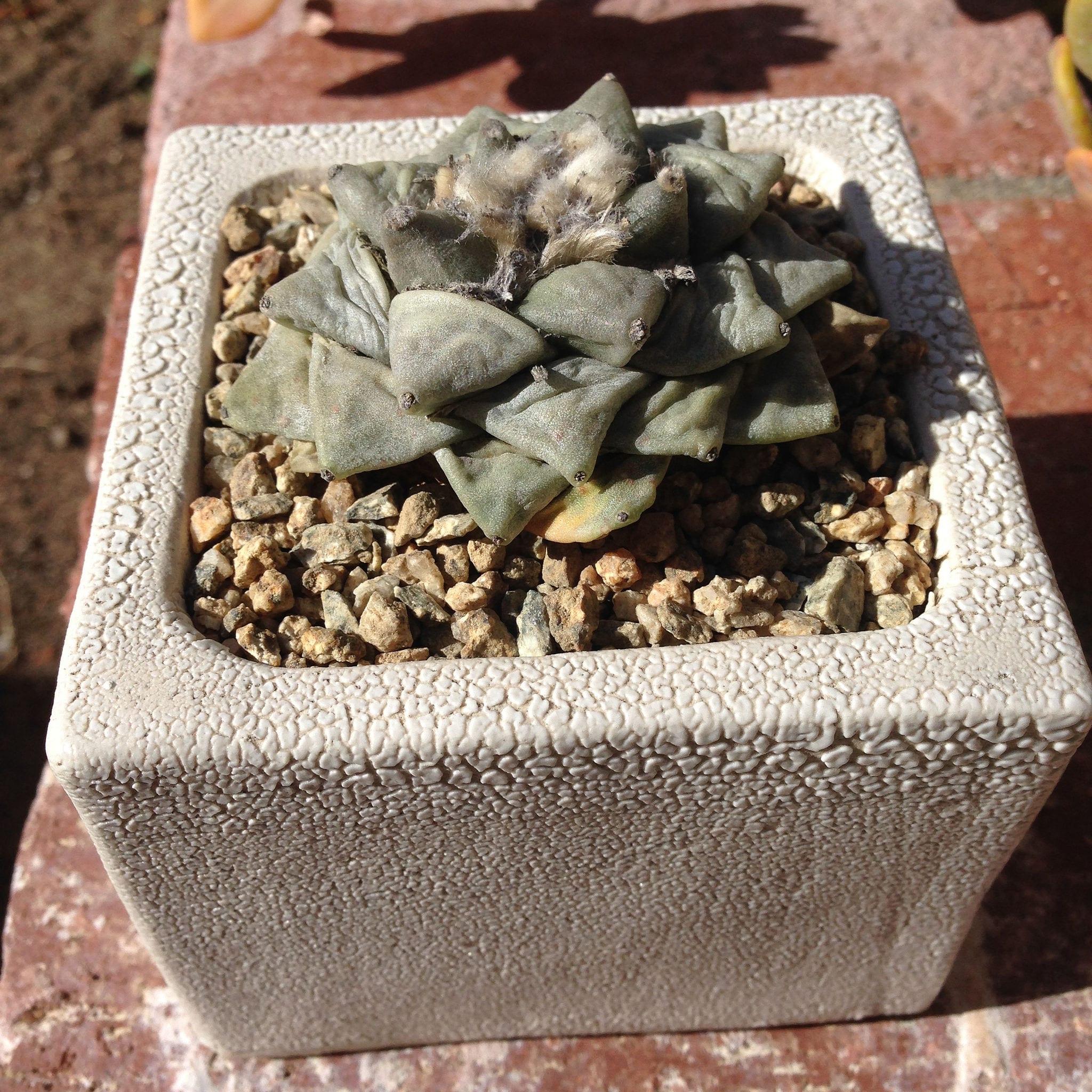
Ariocarpus retusus v. furfuraceus
Image from Flickr / Reggie
When it comes to its cultivation, the most important thing to know is that it should be placed in full sun in a deep pot with a substrate that facilitates water drainage . For this, it is highly recommended to use 100% pumice or washed river sand, as substrates containing peat often prove to be more harmful than beneficial to Ariocarpus retusus.
Furthermore, it needs very little watering , even less than other cacti: once every 10 days in summer and every 20-30 days the rest of the year. It should also be fertilized with a liquid cactus fertilizer following the instructions on the product packaging.
It withstands cold and frost down to -2ºC.