

Image - Wikimedia / The Titou
Crassula ovata is a widely cultivated plant, and for good reason: it doesn't grow very tall, it multiplies easily, it doesn't usually have problems with pests or diseases, and when it blooms it produces small but highly ornamental flowers.
What's more, it can withstand drought, extreme heat, and light frosts. But how do you care for it?
Origin and characteristics
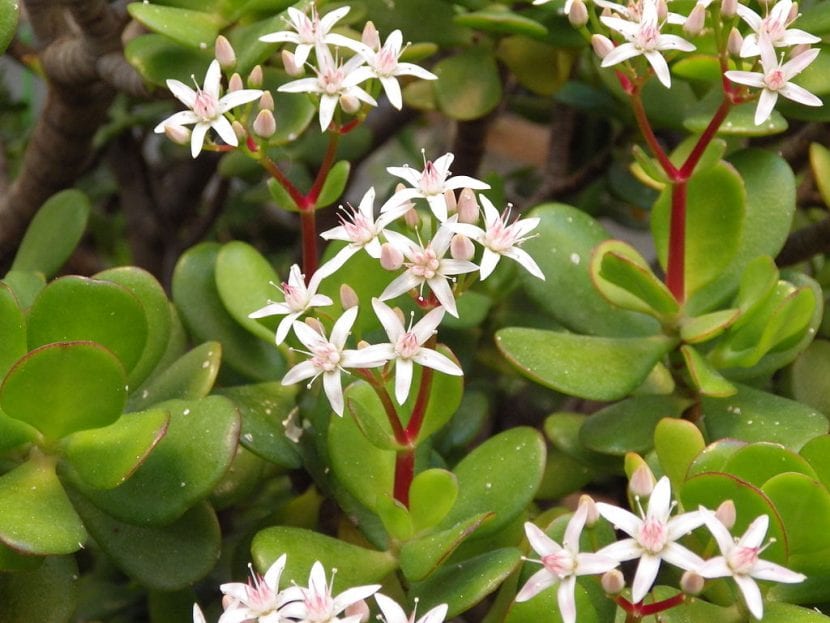
Image - Wikimedia / Aniol
First of all, let's take a look at what it's like, because even though it's a fairly common plant, you can always learn something new. So, in the case of our protagonist, it's an evergreen, succulent shrub native to South Africa that reaches a maximum height of two meters , although it usually stays around 50-60 cm.
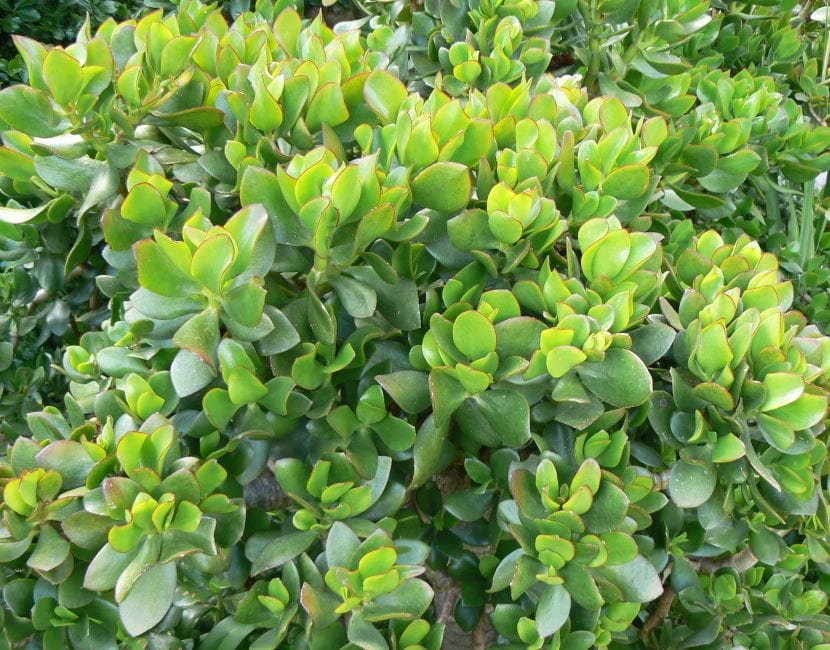
Its trunk is thick, about 10 cm in diameter, with smooth, brownish bark. The leaves are fleshy, jade green, with reddish edges if exposed to high levels of sunlight. It flowers from autumn to winter , producing white or pink flowers composed of five petals.
Cultivars
There are different:
- Crassula ovata cv Gollum: it is very compact, with tubular blades with the tip reminiscent of a suction cup.
- Crassula ovata cv Hobbit: It is similar to the previous one, but its leaves curve backwards.
- Crassula ovata cv. Oblique variegata: it is similar to the type species, but its leaves have yellow-whitish, green and pink stripes.
What are the cares?

If you want to have a copy, we advise you to provide the following care:
Location
It will depend on where you want to have it:
- Interior: it must be in a bright room, close to but not right in front of the window, otherwise its leaves will burn. It is also important that it is away from drafts, both cold and warm.
- Exterior: prefers direct sun, although it also tolerates partial shade.
Earth
- Flower pot- You can use universal growing medium, but it is better to mix it with 10-20% perlite (depending on whether it was already included in the composition or not). In this way, the risk of rotting will be less.
- Garden: grows in well-drained soils. As it is a small plant, if yours is not like that, make a hole of about 50cm x 50cm, cover it with shade mesh and then fill it with the substrate mentioned above.
Irrigation
Crassula ovata is a drought-tolerant plant, but you shouldn't go to the extreme of never watering it. This is only possible if it's planted in the garden and your area receives at least 300mm of rainfall annually; otherwise, you should water it whenever you see that the soil is dry , which will happen frequently in summer.
But, exactly how often to water? It depends a lot on the climate and the characteristics of the soil or substrate. To give you an idea, in my area (Mediterranean coastal climate, maximum temperature of 38ºC and minimum of -1,5ºC, and annual rainfall of 350mm distributed between spring and autumn) it is usually watered about 3 times a week during the season. of more heat, and every 10 days the rest. If where you live is colder or rains more, the frequency of waterings will be less.
Do not wet its leaves or branches, as they could burn and/or rot. It's also not a good idea to put a saucer underneath it, unless you remember to remove any excess water 30 minutes after watering.
Subscriber
From the beginning of spring until the end of summer, it is advisable to fertilize with specific fertilizers for cacti and other succulents, whether liquid or granular, following the instructions specified on the product packaging.
Multiplication
Crassula ovata is propagated by stem cuttings in spring and summer . To do this, cut a branch you like, let the cut end dry for a week in a place protected from sunlight, and finally plant it in a pot with a 50/50 mix of universal potting mix and perlite.
If it is kept moist but not waterlogged, it will emit its own roots after about two weeks.
Planting or transplanting time
In spring , when the temperature remains above 10 degrees Celsius, it will be time to plant it in the garden or transfer it to a larger pot with holes.
Plagues and diseases
It doesn't usually have them, but if the environment is dry and warm you may see some mealybugs that you can remove with a brush soaked in rubbing alcohol or diatomaceous earth.
Pruning
It can be pruned in spring, removing dry, diseased, weak or broken branches, and taking advantage of it to give it a more compact shape.
Rusticity
Crassula ovata can withstand light frosts down to -2ºC if it is sheltered (under a porch for example), but it may lose its leaves if the temperature drops further.
What uses is it given?
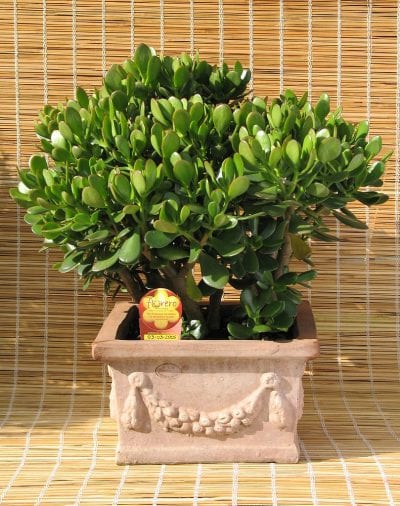
Image - Wikimedia / Arch. Attilio Miletus
Ornamental
The jade plant is so decorative that it looks fantastic both in pots and in the garden . Some people even train it as a bonsai because its growth is so easy to control.
Medicinal
It is used as a poultice to heal burns, and treat the symptoms of arthritis and osteoarthritis. This is made with the juice of 10 to 15 leaves.
What did you think of this plant?
Table of Contents