

H. cooperi var pilifera
Image - Wikimedia / Stan Shebs
Haworthia cooperi is one of the most readily available succulent plants for sale. And there's a reason for that: it's very attractive, hardy, produces small but striking flowers, and, to top it all off, it's easy to propagate.
Because it doesn't grow very large, it's one of those ideal species for use in succulent arrangements. Furthermore, caring for it is quite simple , especially if you keep in mind a few things that I'll explain now.
How is it?

H. cooperi var. truncated
Image - Wikimedia / Levi Clancy
Haworthia cooperi is a perennial, non-cactus succulent native to South Africa. It was described by John Gilbert Baker and published in Refug. Bot. 4 in 1870. It is characterized by its rosettes of 30 to 40 oblong-lanceolate, light green leaves with a flat upper surface and a convex underside. It produces flowering stems about 20 cm tall, at the ends of which sprout very small, whitish flowers, less than 1 cm across.
Its growth rate is rather slow; in fact, it only grows a little fast from when the seed germinates until it reaches a diameter of 4-5cm. Later it does not grow much more in width, although you will see that it has a great tendency to take out suckers.
Varieties
There are different varieties:
- Haworthia cooperi var. cooperate
- Haworthia cooperi var. dielsian
- Haworthia cooperi var. doldii
- Haworthia cooperi var. Gordonian
- Haworthia cooperi var leightonii
- Haworthia cooperi var. pilifera
- Haworthia cooperi var. truncated
- Haworthia cooperi var. Venusta
How do you take care of yourself?

H. cooperi var. gordoniana
Image - Flickr / salchuiwt
If you want to have a copy, we recommend that you provide it with the following care:
Location
Being a rather small plant, it can be kept in the garden, on the patio, or on the terrace . However, in any case, it must be in an area where it receives sunlight all day, but only if it has been accustomed to it beforehand, otherwise it could get sunburned.
Earth
It grows in sandy, and even rocky soils, so that the cultivated land must be:
- Garden: with good drainage. Mix if necessary the soil with perlite, claystone, volcanic clay or similar at 50%.
- Flower pot: it can be had simply in the cheek; Although it does not go bad either with black peat mixed with perlite or river sand mixed in equal parts.
Irrigation
The watering frequency for Haworthia cooperi will remain fairly consistent. During autumn and especially winter, it's necessary to water it considerably less, but generally, one or two waterings per week will suffice . If you live in an area prone to frost, water it once a month.
And by the way, when you water, only wet the soil, never the plant, otherwise it could get sunburned or rot.
Subscriber

H. cooperi var venusta
Image - Wikimedia / S Molteno
It is a plant that grows a good part of the year, except when the temperature drops below 15ºC or exceeds 35ºC. This means that, depending on the weather, it will remain very active for an average of six months.
To be healthy, apart from water it needs to be fertilized regularly in spring and summer , either with specific fertilizers for cacti and other succulents following the instructions specified on the packaging, or with one or two small spoonfuls of blue Nitrofoska every 15 days.
Planting or transplanting time
In late winter , once the risk of frost has passed. If it's in a pot, it should be repotted every two years when young. Once it reaches its final size, simply renew the potting mix every 3 or 4 years.
Multiplication
Haworthia cooperi is propagated by seeds and by offsets in spring and summer. Let's see how to proceed in each case:
Seeds
The step by step to follow is as follows:
- First, a tray must be filled - it must be at least 20cm in diameter by about 5cm high, with holes - with black peat mixed with 50% river sand.
- Then, it must be watered conscientiously.
- The next step is to spread the seeds, ensuring that they are not piled up.
- They are then covered with a thin layer of black peat.
- Finally, the tray is placed in a bright place but not in full sun.
They will germinate in 2-3 weeks.
Young
The shoots can be separated from the mother plant when they are a size that is easy to handle, such as 3-4 cm. They are then planted in individual pots, and that's it .
Plagues and diseases
Haworthia cooperi is very hardy . The only thing to watch out for is mollusks (snails and slugs), as they enjoy eating its leaves. But don't worry, with the tips we offer in this article you can keep them away.
Rusticity
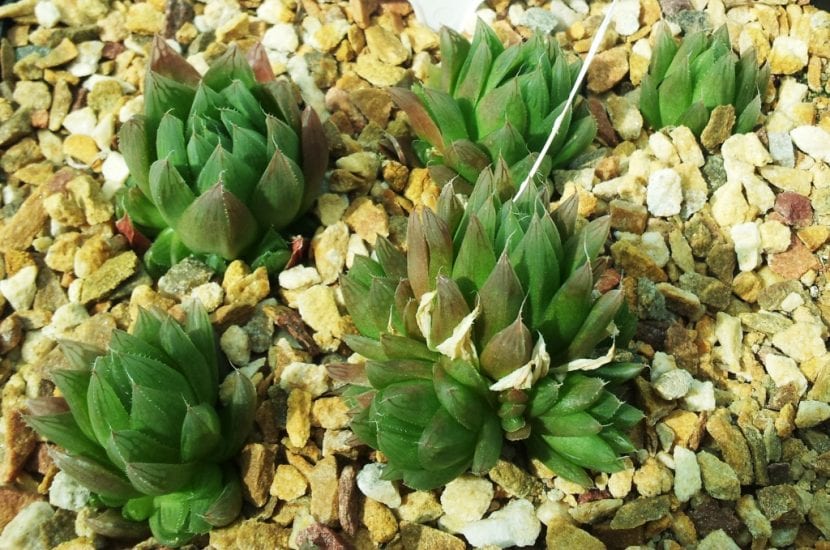
H. cooperi var leightonii
Image - Wikimedia / Abu Shawka
It can withstand frosts down to -3ºC , but needs protection from hail, especially when young.
What do you think of this succulent plant? Did you know it? Now you know that it is easy to maintain, as well as having a very interesting ornamental value .
Table of Contents