

Image - Wikimedia / Abu Shawka
Haworthia fasciata is one of the first succulent species that people usually buy when starting a collection, or when looking for a small plant to have on a table or terrace.
It is very easy to take care of. So much so that I would dare to say that it is one of the best to start in the succulent world. In addition, not only will you have to worry little about watering, but if you wanted, you could separate your children and have many little plants.
Origin and characteristics of haworthia fasciata

Image - Wikimedia / Abu Shawka
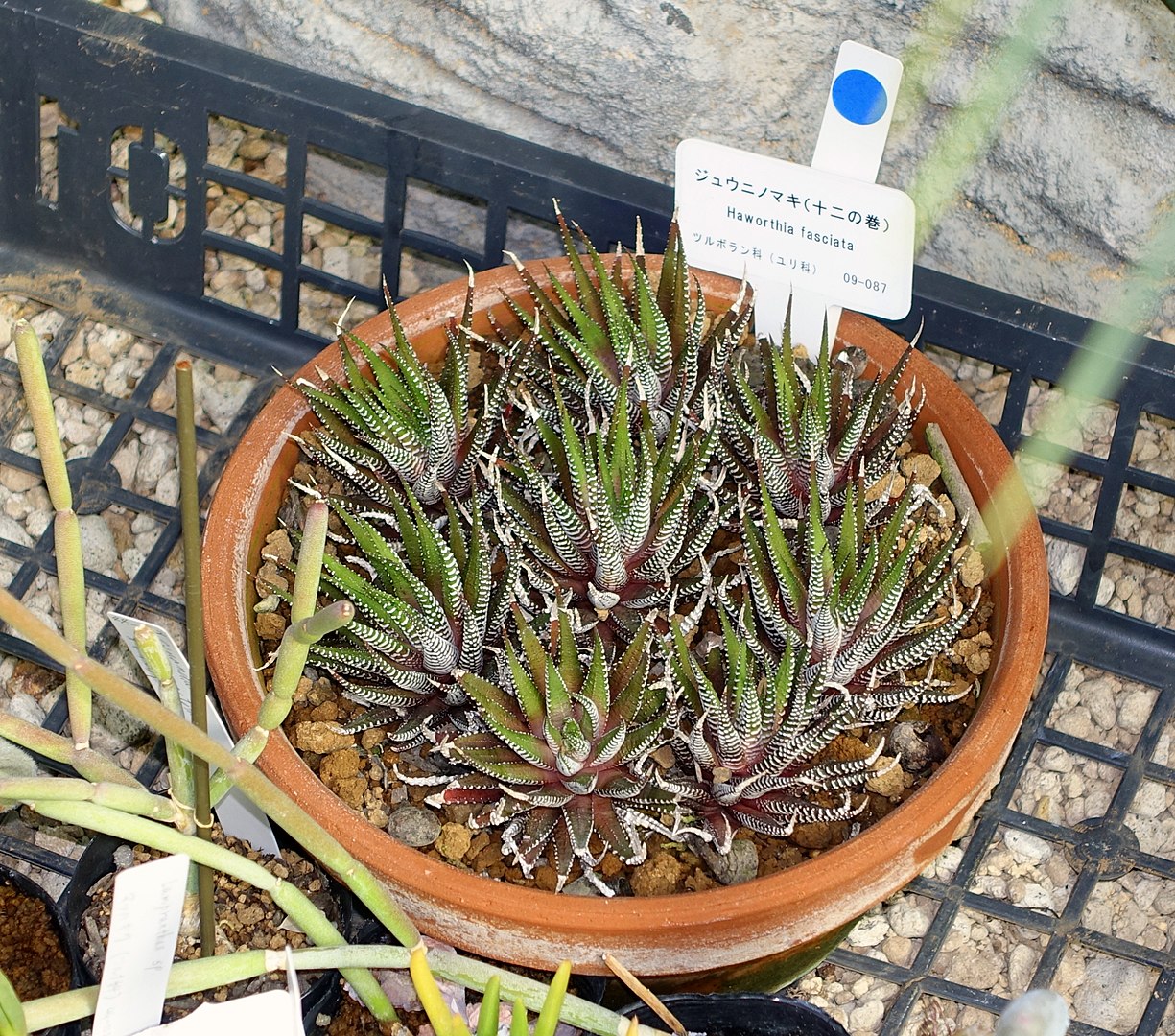
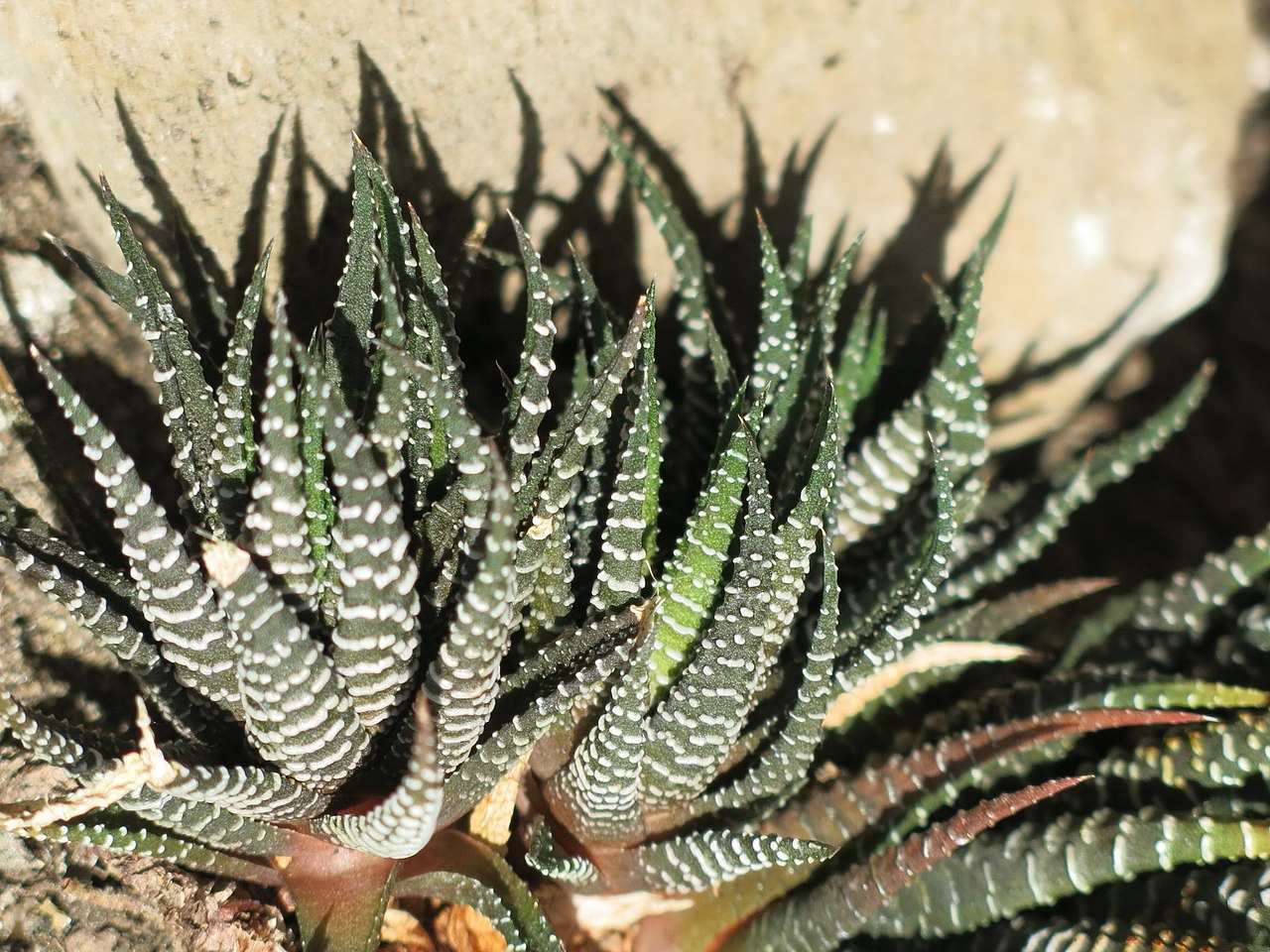
Haworthia fasciata is a non-cactus succulent native to South Africa. It forms rosettes of dark green, triangular leaves with numerous white, crested spots on the underside and fewer on the upper surface . Each leaf has a spine at its tip, but it is harmless as it is not sharp. The total height does not exceed ten to fifteen centimeters.
It blooms in spring , producing a long flower stalk that can measure up to 40 centimeters. At the end of this stalk emerge several small, white flowers with light reddish-brown lines. The fruit is a very small, dry capsule containing the seeds.
They tend to sprout numerous offshoots, so many that they form groups which, although not very large, do force you to plant them in a wide pot, about thirty centimeters in diameter.
What are the care you need?
If you decide to own a copy, we recommend that you take care of it in the following way. This will reduce the risk of unforeseen events arising :
Location
- Exterior: since it is a plant that resists high temperatures and even some frosts, the ideal would be to have it all year round (or at least in spring and summer) outside the home, in semi-shade.
- Interior: It may be inside the house, but the room in which it is placed must be very clear. Also, it should be away from drafts, and a little away from windows.
Irrigation
To avoid unnecessary risks, allow the soil or substrate to dry completely before watering again . Keep in mind that in case of problems, it will always be easier to revive a plant that has suffered from thirst than one that has been drowning, especially when it comes to succulents.
That is why, if you have doubts, you should check the humidity of the soil or the substrate, either by inserting a stick or, if you have it in a pot, weighing it once watered and again after a few days. On the other hand, it is advisable not to put a plate under it, because if the roots are always in contact with stagnant water, they will rot ... and with them the leaves.
Earth
- Flower pot: mix universal substrate with perlite in equal parts. In case of living in a humid place (either due to rain, living on an island and / or being near the coast), use coarse sand, type pumice better (for sale here) or akadama.
- Garden: the soil must be rather limestone, and have good drainage. It grows on stony ones as long as it has some soil to root.
Subscriber
To ensure healthy growth, you can fertilize with a succulent fertilizer from early spring until late summer . If you live in an area with a mild climate, without frost or with very mild frosts, you can fertilize until autumn.
Of course, you have to follow the instructions that will be specified on the package to the letter, otherwise you could cause damage by overdose of fertilizer.
Planting or transplanting time
Haworthia fasciata can be planted in the garden or repotted in spring. However, given that it is a rather small plant that tends to produce offsets, we recommend the following:
- Garden: put in an area a little separate from what is the garden itself, as in a planter with other succulents.
- Flower pot: 2, maybe 3 transplants will be needed throughout your life. You can even leave for example 3 (the mother plant with two children) in one and plant the other suckers in other pots.
Multiplication
It multiplies by seeds and separation of suckers in spring-summer.
Seeds
The seeds should be sown in shallow but wide trays , with universal substrate mixed with perlite in equal parts, and ensuring that they are slightly separated from each other.
Next, place the seed tray outdoors in partial shade and keep it watered. They will germinate in about 15 days. However, it's important to know that it hybridizes very easily with other Haworthia species, which makes obtaining pure H. fasciata specimens a bit difficult.
Separation of suckers
The pups can be separated from the mother plant when they are about 3-4 centimeters long. By gently digging the soil, you can remove them by the roots , and then simply plant them in other pots in partial shade.
Plagues and diseases
It's quite hardy, but you should watch out for mealybugs and snails . Since it's a small plant, if you see any pests, they're easy to remove with a brush.
Another option is to use organic insecticides, such as diatomaceous earth , which also serves as a gentle fertilizer. Just sprinkle a little around the area, and you're done.
Rusticity
Haworthia fasciata can withstand frosts down to -2°C , perhaps even -3°C for short periods. However, it's preferable that the temperature doesn't drop below 0°C.
Where to buy?
Get your plant from here.
What did you think of this succulent?
Table of Contents