

It's probably the most well-known deciduous plant in the world: the desert rose, or Adenium obesum, is not just beautiful, it's beyond beautiful . It also has a characteristic that captivates everyone who sees it: it blooms at a very young age!
The problem is that it's not very easy to care for if the weather isn't great. But don't worry, by following my advice you'll be able to keep it going.
How is it?
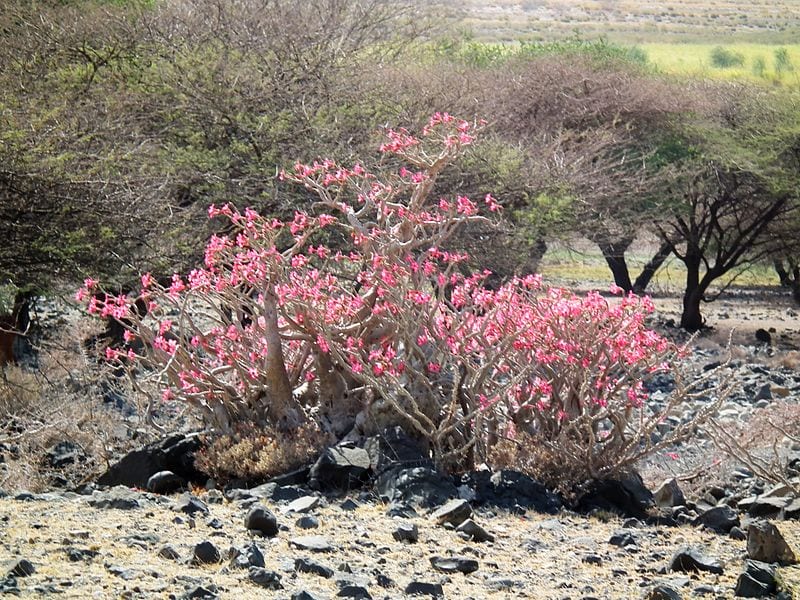
Adenium obesum is the scientific name of a caudex-bearing plant native to eastern and southern tropical and subtropical regions of Arabia and Africa. It is commonly known as Desert Rose, Winter Rose, Sabi Star, or Kudu. It was described by Peter Forsskal, Johann Jacob Roemer, and Josef August Schultes and published in Systema Vegetabilium in 1819.
It reaches a height of 1-3 meters , with simple, entire, leathery leaves, 5-15 cm long and 1-8 cm wide. The flowers are tubular, 2-5 cm long, and composed of five petals, 4-6 cm in diameter. They appear in spring and can be pink, red, or white.
Subspecies
- Adenium obesum subsp. boehmianum: native to Namibia and Angola.
- Adenium obesum subsp. obesity: native to Arabia.
- Adenium obesum subsp. oleifolium: native to South Africa and Botswana.
- Adenium obesum subsp. socotranum: native of Socotora.
- Adenium obesum subsp. Somali: native to East Africa.
- Adenium obesum subsp. Swazicum: native to eastern South Africa.
What special care do you need to live?
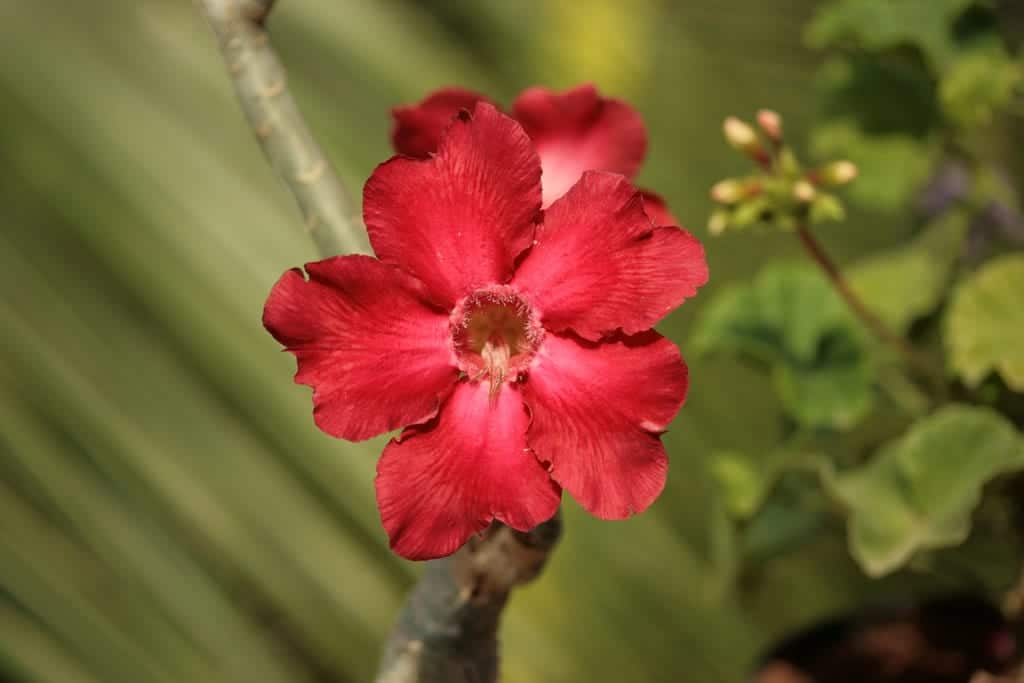
Now that we know what it looks like, it's time to learn how to care for it. Well, the first and most important thing to keep in mind is that the desert rose is a plant that cannot tolerate frost . This means we can't grow it outdoors year-round if winter temperatures drop below freezing. So, how do we prevent it from dying?
For this, it needs very little watering throughout the year: once a week and every 15-20 days the rest of the year. As soon as the temperature drops to 10ºC or lower, we'll make a greenhouse for it—an old shelf and clear plastic are more than enough—and we'll start watering it once a month. I don't recommend keeping it indoors unless your area experiences frosts of -3ºC or lower, as it doesn't adapt well to those conditions.

Another thing we need to do is plant it in a pot with a substrate that drains water quickly . For this, I recommend planting it in pumice, which is a type of gravel but with much smaller grains and a white color. Also, during spring and especially summer, it should be fertilized with a liquid fertilizer for cacti and other succulents, or if you prefer, with blue nitrophoska.
Transplanting should be done in spring , as soon as the season has warmed up. It's very hardy, but you have to be careful with its roots and not water it for about 15 days.
This way you will have a better chance of survival.
If you have any questions, just ask.
Table of Contents