

Image - Wikimedia / James Steakley
Aeonium arboreum is one of the most popular succulents in the world, and for good reason: it's incredibly easy to care for and propagate, and it's also beautiful. It's a rewarding species that requires only minimal care to thrive.
Perhaps the only drawback is that it requires direct sunlight, but otherwise it's sure to bring you a lot of joy.
Origin and characteristics of Aeonium arboreum
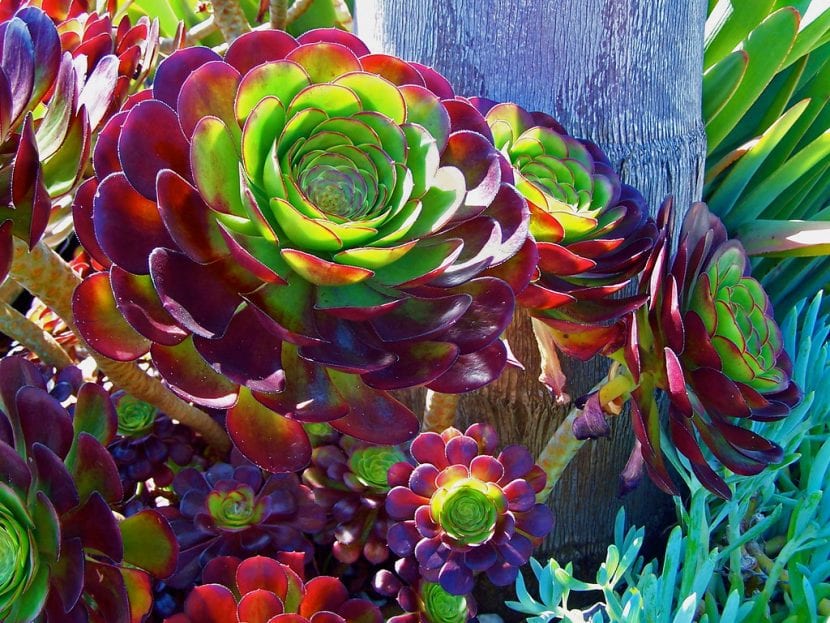
Image - Flickr / Trace Nietert
This species is native to the Atlantic coast of Morocco and the Canary Islands, where it grows in open fields. It is known as the aeonium, tree houseleek, or simply aeonium. It reaches a maximum height of 90 centimeters , with extensively branched stems from which rosettes of leaves 15 to 20 centimeters in diameter emerge. These leaves can be green, brown, brown with a green center, or variegated, depending on the variety and/or cultivar.
It blooms at the end of winter, developing an inflorescence of about 15 centimeters with yellow-cream flowers. After the wilting of these, the branch dies.
Varieties
There are two well-known varieties:
- Aeonium arboreum var atropurpurea
- Aeonium arboreum 'Scharzkopf'
They are characterized by having dark purple leaves , which is accentuated by the sun.
What are their cares?
If you want to have a copy, we recommend that you provide it with the following care:
Location
The Aeonium arboreum is a plant that needs plenty of sun to thrive , so it should be kept outdoors in an area exposed to the sun's rays so that it can grow healthy.
Earth
Being a relatively small species, you can have it both in a pot and in the garden, so the type of soil will vary:
- Flower pot: since it is not demanding, fill it with universal substrate (for sale here). Now, it is highly recommended to mix it with 30% perlite.
- Garden: grows in well-drained soils. Tolerates limestone.
Irrigation
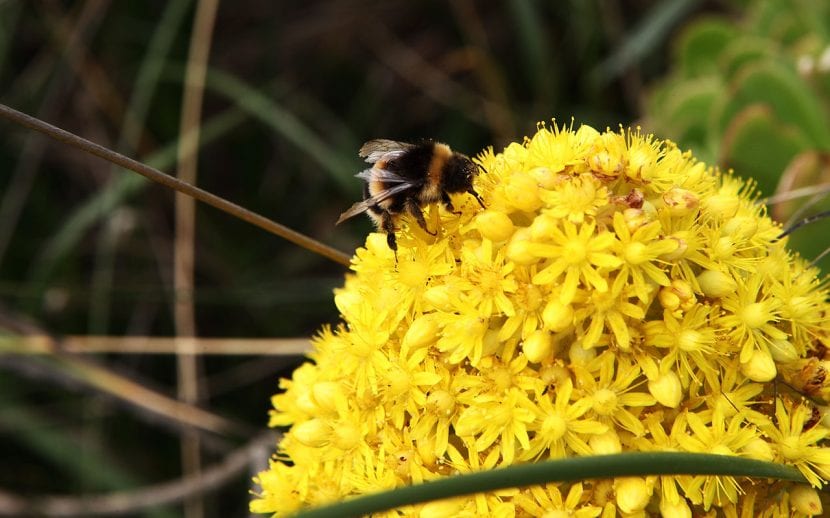
Image - Wikimedia / Magnus Manske
Watering should be infrequent but regular . Aeonium arboreum can withstand periods of drought of varying lengths (from experience, I can tell you that, provided it has been in the ground for more than a year, it can easily survive 3 or 4 months without any water), although it's best to avoid this if you want it to look beautiful year-round. Therefore, with this in mind, during the summer, 2 or at most 3 waterings per week will suffice, and the rest of the year, water once every 7 to 10 days.
Of course, every time it is watered, it must be watered well, that is, moistening the entire substrate or soil. In addition, it is important that the watering is done at dusk, since if it is done in the morning or at noon the water would evaporate quickly and the roots would hardly be able to take advantage of it.
Subscriber
Throughout the growing season , that is, from spring until the end of summer (or even until autumn if the weather is mild) it is advisable to fertilize it from time to time with succulent fertilizers (on sale here ).
If you prefer to use natural products, guano, for example, is highly recommended. It's simply the manure of seabirds or bats (you can buy it here ). Regardless of your choice, read the instructions on the product packaging to avoid the risk of overdose.
Multiplication
Aeonium arboreum is propagated by seed, and especially by cuttings in spring or summer. Let's see how it's done:
Seeds
The seeds should be sown in seed trays or pots with holes filled with succulent soil (available here , for example). Then they are covered with a thin layer of substrate and watered.
Finally, the seedbed is placed outside, in semi-shade, and the substrate is kept moist. In this way, they will germinate in about 20 days.
Cuttings
It's the quickest and most effective way to propagate new plants. Simply cut a branch, let the cut dry for a week, and then plant it (don't stick it in) in a pot with well-draining potting mix, such as pumice.
It is not necessary to use rooting hormones, although they are not a bad idea either . Place the pot outside, in semi-shade, and water about 2-3 times a week.
After about two or three weeks it will emit its own roots.
Plagues and diseases

Image - Flickr / Ali Eminov
It is quite resistant to both insect pests and microorganisms. However, over the seasons, if there are any errors in cultivation, it can be affected by mealybugs , especially scale insects, and also spider mites.
Both pests can be treated with diatomaceous earth (available here ), and even with water and neutral soap.
Planting or transplanting time
The time to plant it in the garden or move it to a larger pot is in spring, when the risk of frost has passed.
Rusticity
It withstands frosts down to -4ºC.
What uses is given to Aeonium arboreum?
It's a plant used as an ornamental in gardens, patios, balconies, and terraces. It's easy to grow and care for, and its mild frost tolerance makes it a very attractive option.
Do you have any copies?
Table of Contents