

Sempervivum tectorum
Houseleeks are among the easiest non-cactus succulent plants in the world to care for. They withstand drought, sub-zero temperatures, and heat (though not extremes), and they also multiply very easily and quickly.
But do you know where they come from? If you'd like to learn more about their world and how to cultivate them better, we'll tell you all about them below .
Origin and characteristics
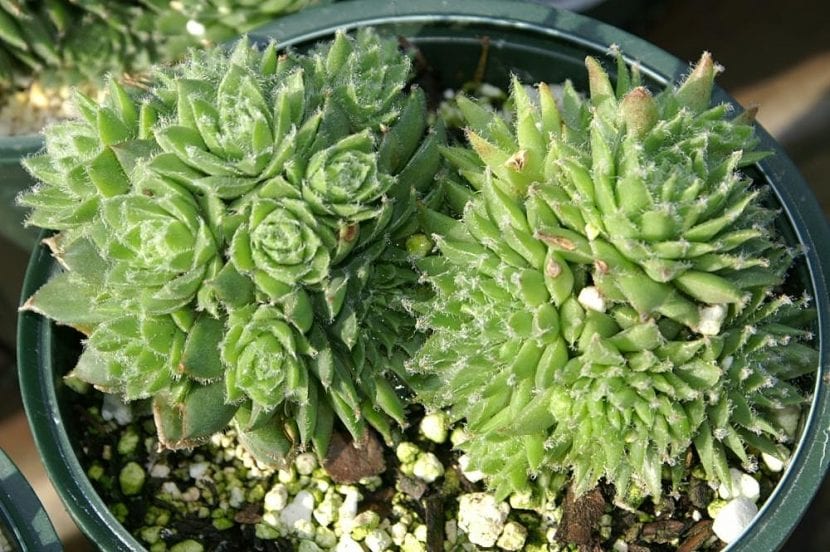
Sempervivum pilioseum // Image - Wikimedia / David J. Stang
These are non-cactus succulent plants, or simply succulents, belonging to the genus Sempervivum, native to Spain (mountains of the Iberian Peninsula and the Canary Islands), the Carpathians, Turkey, Armenia, and the Caucasus. They form rosettes of monocarpic leaves, meaning that after flowering they die, leaving new offshoots that sprout from their roots.
They grow to heights of no more than a foot; however, they can occupy a very large space, exceeding fifty centimeters if they are allowed to grow freely.
Main species
The genus is made up of around thirty species, the following being the most popular:
Sempervivum tectorum

Image - Wikimedia / Qwertzy2
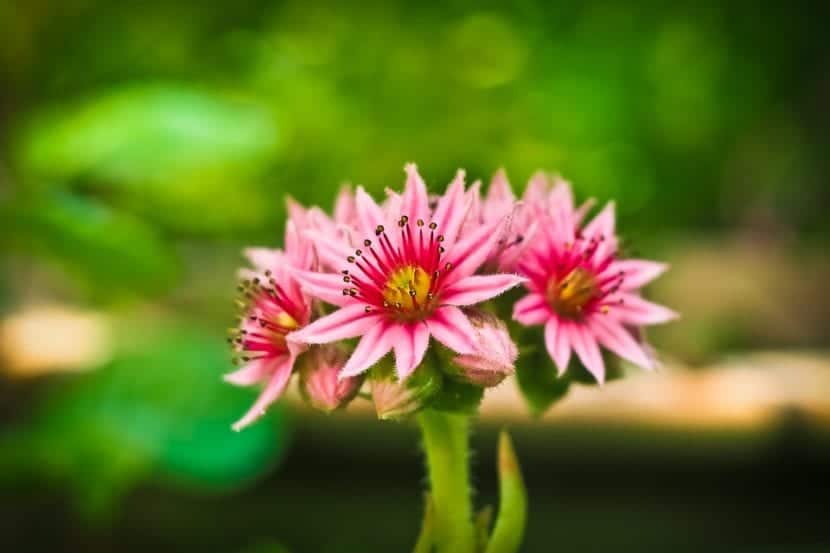
It is native to the northern Iberian Peninsula. It grows to a height of 50 centimeters and a width of 15-30 centimeters . The leaves are greenish with purplish tips. Its pink or reddish flowers bloom from a long stem 30-50 centimeters tall during the summer.
Sempervivum montanum

Image - Wikimedia / Guérin Nicolas
It is native to the Pyrenees, Alps, Carpathians, and Corsica. It grows up to 20 centimeters tall and 20-40 centimeters wide , producing matte green leaves. Its purplish-red flowers bloom from a stem about 15-20 centimeters tall in summer.
Sempervivum arachnoideum
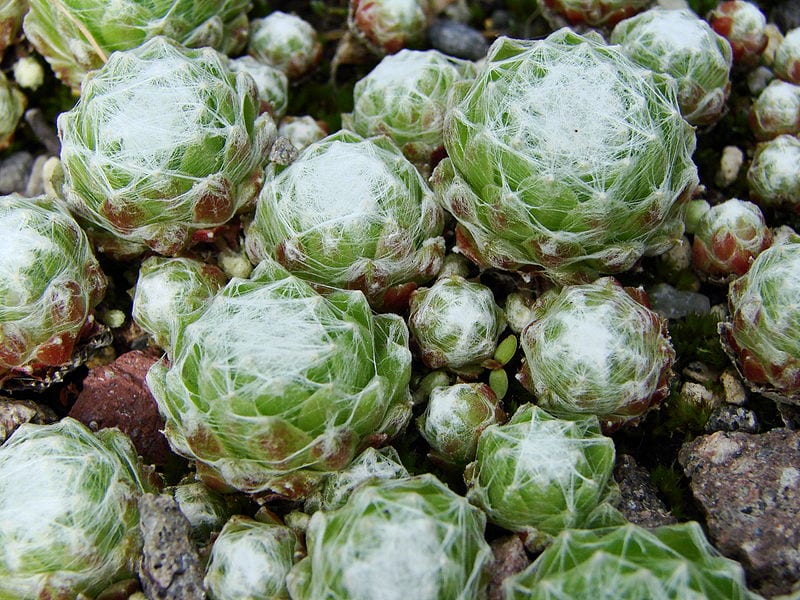
Image - Wikimedia / Guérin Nicolas
Known as the spiderweb houseleek, it is native to the Alps and the Carpathian Mountains. It grows to 10-15 cm tall and about 35 cm wide . The leaves are green, and from each tip appear to produce fine white "hairs" similar to the webs spun by spiders. In summer, its red flowers bloom on stems up to 15 cm tall.
Sempervivum calcareum
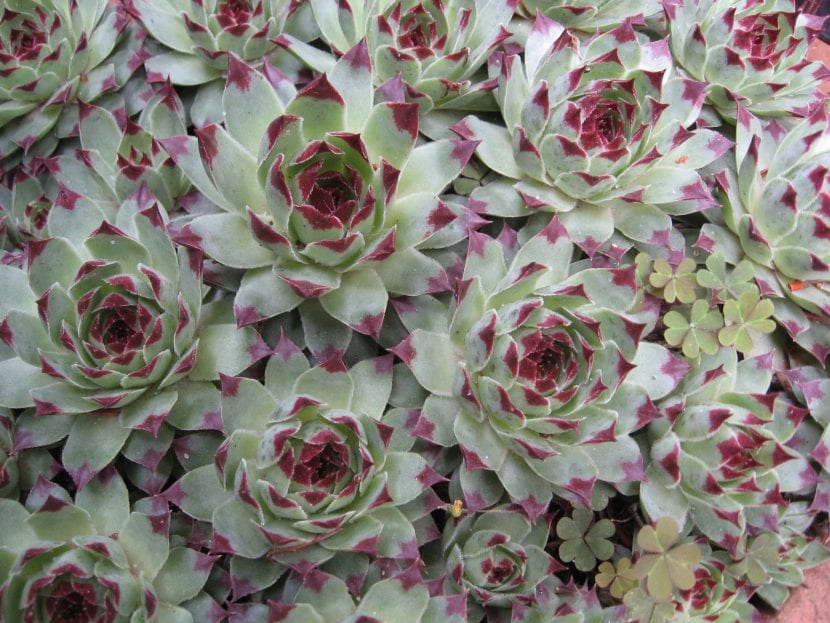
Image - Wikimedia / Cillas
It is native to the Alps and grows up to 20 centimeters tall and 30 centimeters wide . The leaves are green with reddish-purple tips. It is very similar to S. tectorum , but this one only grows in the Alps, is smaller, and has more pronounced reddish-purple tips.
What is the care of the immortelle?
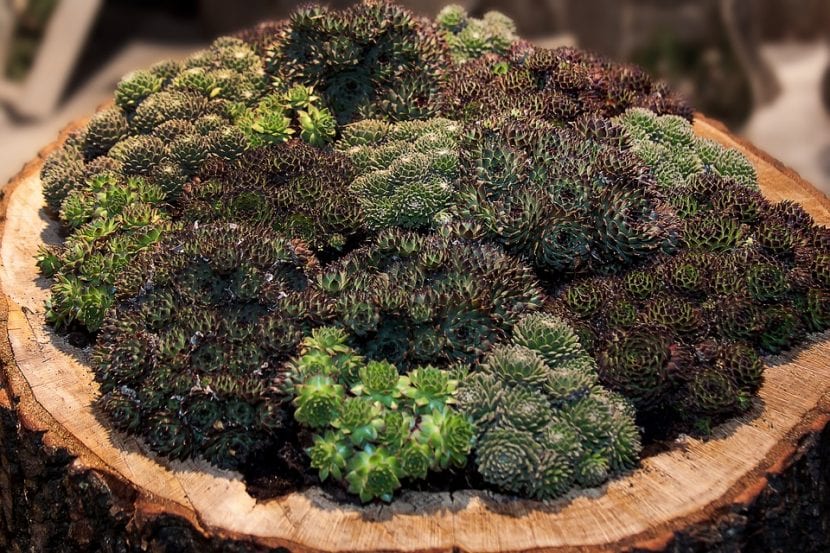
If you want to have a copy (or a few and make compositions as beautiful as the one in the image above), here are a few tips:
Location
They are plants that have to be outside, but where exactly? Well, it depends a lot on the weather:
- Temperate-cold: If you live in an area where frosts occur and where temperatures in summer are mild, you can have them in direct sun.
- Temperate-warm / warm: if you live in an area where temperatures are mild except in summer when they are high, it is best to put them in semi-shade.
Irrigation
As we mentioned at the beginning, they are very drought-resistant, but for them to develop properly and stay healthy, it's not advisable to leave them without water for weeks at a time . In fact, I can tell you that I, living in the Mediterranean with temperatures up to 38ºC in the middle of summer, where drought lasts for months, would lose them if I didn't water them once or twice a week during the hottest season and every 10-15 days the rest of the year.
And it is that the insolation here is very high, so much that it makes the substrate dry very quickly, almost overnight. For this reason, if the climate you have in your area is similar, you should also water from time to time.
Of course, if on the contrary it tends to rain regularly, space out the waterings, because watering little is as bad as watering a lot. If in doubt, check the humidity of the soil, for example by weighing the pot once it has been watered and again after a few days, or with a thin wooden stick (if it comes out with a lot of adhering soil when you remove it, do not water).
Subscriber

Image - Wikimedia / Meneerke Bloem
From early spring to late summer, it's advisable to fertilize it with organic fertilizers, such as guano. But if you only have it as an ornamental plant, use fertilizers specifically formulated for succulents, following the instructions on the packaging.
Multiplication
Sempervivum plants are propagated by separating runners in spring and summer. To do this, simply use scissors that have been disinfected with alcohol to separate the runners with a small amount of root attached and plant them in pots filled with a 50/50 mix of universal potting mix and perlite.
Then, you just have to take care of it like a normal plant .
Rusticity
It withstands cold and frost down to -18ºC , but extreme heat (over 38ºC) doesn't suit it very well.
What uses does it have?
Ornamental
It is very decorative. As it forms rosettes of not very tall leaves, it is perfect for growing in pots as specimens of a single species, or for creating compositions.
Medicinal
Since ancient times, these plants have been used for their anti-inflammatory properties, as well as for treating infections such as otitis, tracheitis, pharyngitis, and candidiasis . Juices made from the leaves are also used to remove calluses and freckles.
What do you think of these plants?
Table of Contents