

Image - Worldofsucculents.com
The candelabra cactus is a jewel of the American desert . Although it has a rather slow growth rate, it is an easy-to-cultivate species that drives all lovers of spiny succulents with a tree-like appearance wild.
If you have a large space and want to show off your garden, don't hesitate, get a Browningia candelaris ; I'll take care of providing you with its calling card .
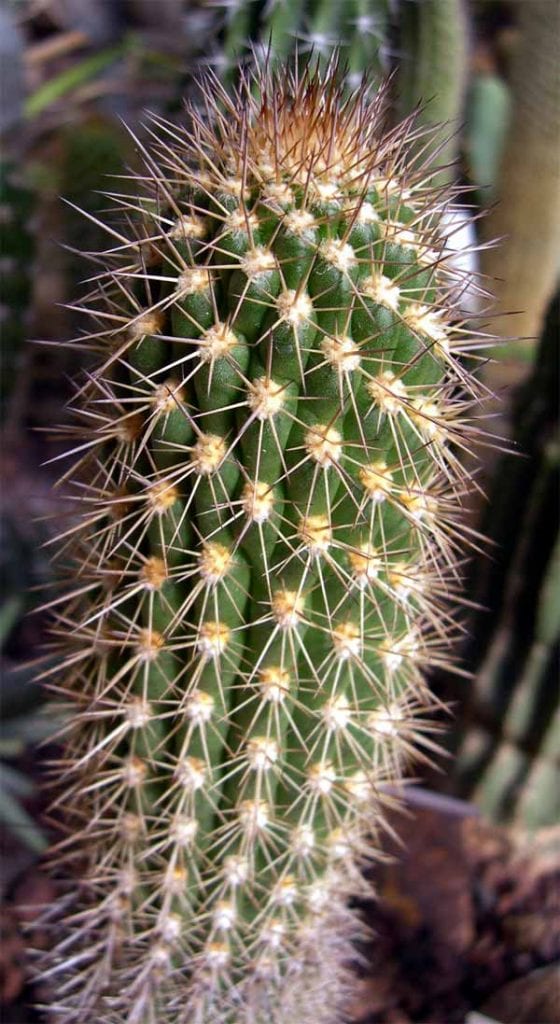
The candelabra cactus, whose scientific name is Browningia candelaris , is a species of cactus endemic to the high plateau of Chile and Peru . It was first described in 1833 as Cereus candelaris by the German botanist Franz Julius Ferdinand Meyen. In 1920, Britton and Rose placed it in the genus Browningia.
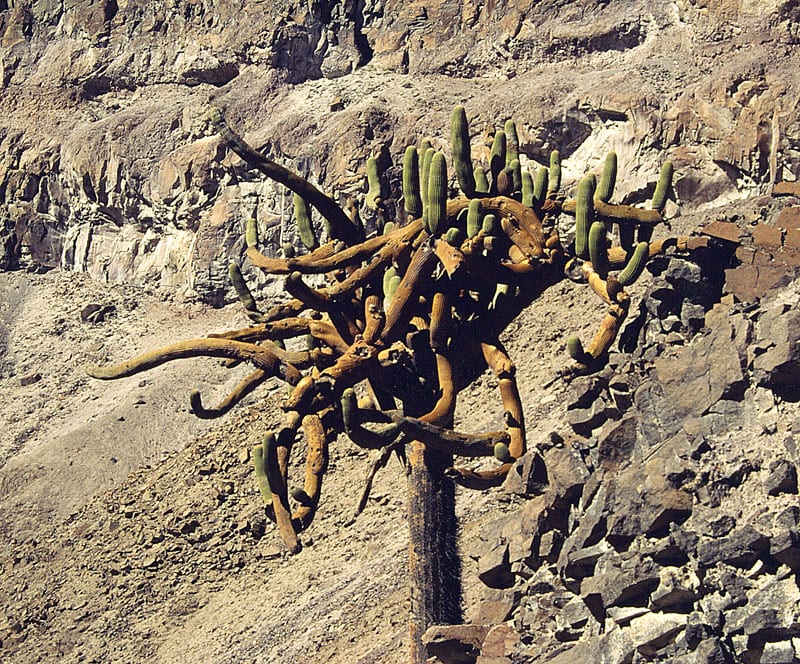
It grows between 1700 and 3000 meters above sea level. It reaches a height of up to 5 meters and has a branched, well-armed tree-like form with straight, brown thorns 6-15 cm long. The highest branches may or may not have thorns. All branches have around 50 ribs. Its trunk is straight, with a thickness of up to 50 centimeters.
The flowers are tubular, white, 8-12 cm long, and bloom during the day . Once pollinated, the fruits begin to ripen and eventually become edible.
In terms of its care, it's worth noting that this is a somewhat delicate species. It needs sunny locations to thrive and a well-draining substrate, as it doesn't tolerate waterlogging. Furthermore, it should not be overwatered ; water only when the soil is completely dry.
Being slow-growing, we can cultivate it for many years in a pot , which will undoubtedly be good news for those who live in areas where the winter is cool, as this wonderful cactus does not withstand frost.