

Euphorbia enopla is one of the best-known spiny succulents. It's a magnificent low shrub with numerous branches that grow very close together, well protected by grayish-white spines, except for those at the top, which are red. Like all flowering plants, it produces flowers, but they are so small that they sometimes go unnoticed. For this reason, it is cultivated more for its rarity and ease of care.
It looks like a real cactus, but the fact that it lacks areoles sets it apart. However, its needs are similar; in fact, when you want to buy one, you have to go directly to the table where they are displayed, or get it from a specialized nursery. So don't hesitate to learn all about Euphorbia enopla.
How is it?
Euphorbia enopla is a shrub native to South Africa that grows in a candelabra shape . Its branches are thin, 1-2 centimeters thick, and well-armed with thorns that measure 1-1.5 centimeters in length. It may have leaves, but they are very small and not always present: the green stem is responsible for photosynthesis, allowing it to better withstand drought.
It reaches a height of approximately 90 centimeters . As we mentioned, it is a flowering plant, and it blooms in spring. The flowers are grouped in inflorescences and can be either female or male. The female flowers are larger than the male ones and are red.
There is a very curious variety, Euphorbia enopla f. cristata , which is this:

Image - Flickr / Cerlin Ng
As you can see, it has a rounded shape, but it still has its spines. It reaches a lower height, about 20-30 centimeters, and is sometimes sold grafted.
How to take care of it?
Euphorbia enopla is easy to care for . It's a very hardy plant that you can grow in a pot for a very long time. In fact, it's often kept in a container throughout its entire life.
Therefore, even if you don't have a garden, if you want a thorny plant suitable for beginners, don't hesitate to get a specimen of this species. Surely with the advice that we are going to give you below you will have it beautiful:
Location
This is a plant that needs to be placed in a location with plenty of light . If it's going to be outdoors, it's best to keep it in a sunny spot so it can grow well.
In the event that it is going to be inside the house, we will put it in a well-lit room. Ideally, there would be windows through which the sunlight would enter, but it would also be worth having the roof be glazed, or even putting it near the window whenever we rotate the pot a little every day.
Earth
- Flower pot: it is not a cactus, but having similar needs it can be planted in a pot with substrate for these types of plants (on sale here). An alternative would be the universal substrate mixed with perlite in equal parts.
- Garden: It is important that the garden soil drains water quickly, and that it is light. The roots of this plant do not tolerate excess water.
Irrigation
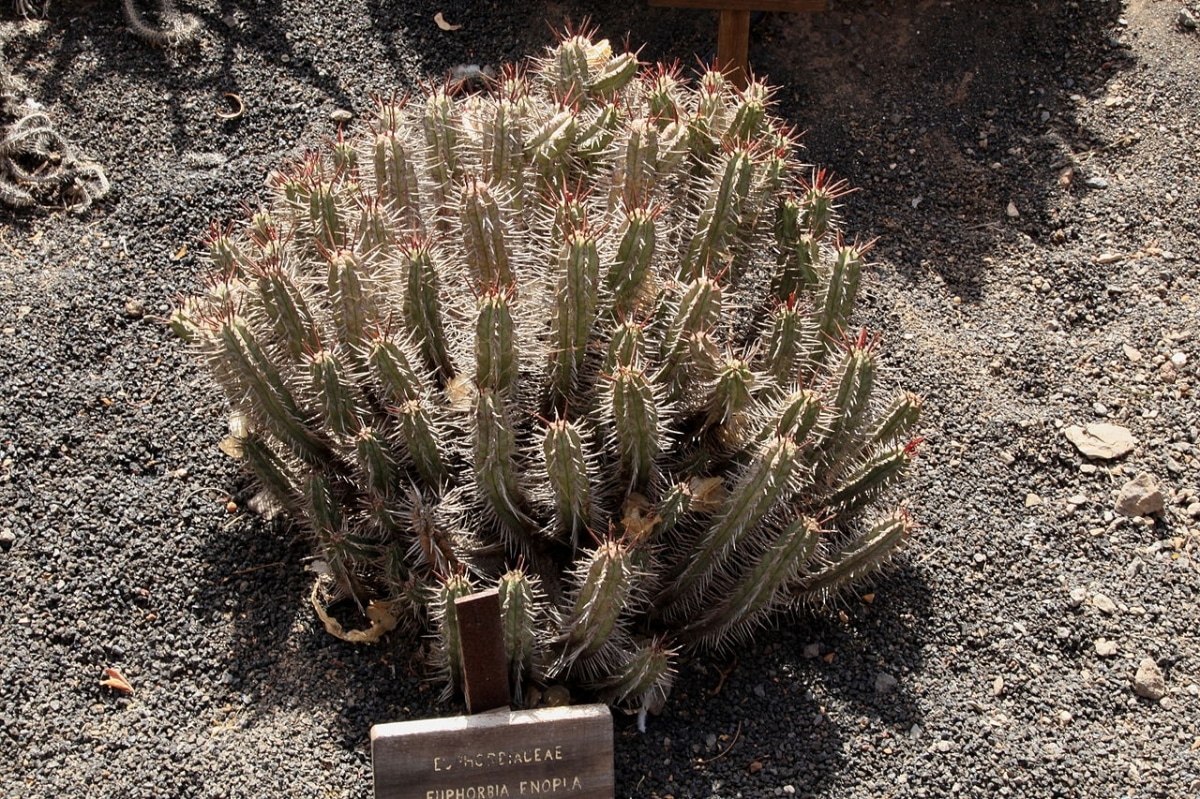
Image - Wikimedia / Frank Vincentz
Watering should be occasional. It should only be done when the soil is dry , as it tolerates drought very well but not waterlogging. For this reason, when watering, add water until the substrate is thoroughly moistened, but do not water again for a few days.
The roots need time to hydrate, but also to dry out a little. This way, the Euphorbia enopla will grow very well.
Subscriber
It's advisable to fertilize it from the beginning of spring until the end of summer . For this, you can use liquid fertilizers for cacti and succulents (available here ), but it's important to follow the instructions on the packaging. If you use more than indicated, the roots will burn and the plant may never recover.
Transplant
Euphorbia enopla may need a larger pot every 2 or 3 years . You'll know this is necessary if you see roots growing out of the drainage holes. When repotting, it's important to handle the roots gently and place it in a container that is about 4-5 centimeters wider and taller than the one it has been using.
In addition, you have to wait for spring to arrive, and for the temperatures to finish recovering. Only when the minimum is at least 18ºC can you transplant it. In the event that you want to keep it on the ground, you will also have to wait for the temperatures to recover.
Multiplication
It is multiplied by cuttings in spring.
Rusticity
It can withstand very light, short-lived frosts down to -2ºC, provided it's grown in a sheltered area. In fact, it's best kept indoors or in a greenhouse during the winter if temperatures drop below freezing.
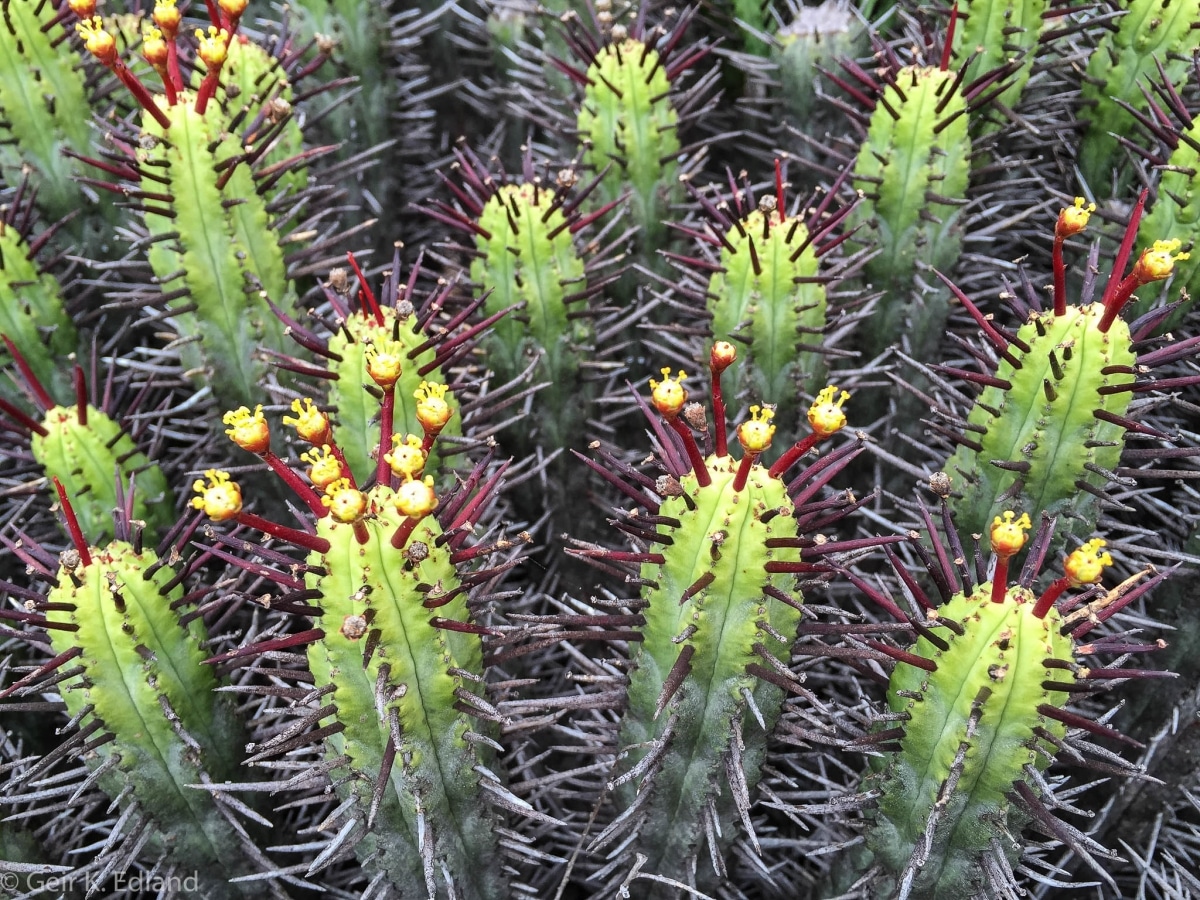
Image - Flickr / Geir K. Edland
Did you know about Euphorbia enopla ? It's certainly a very curious plant that deserves a place in our collection, don't you think?
Table of Contents