

Image - Wikimedia / [H. Zell]
But it must also be said that they are precisely its thorns and the shape it takes are the characteristics that give it that beauty that more than one wants to be able to contemplate every day. This is almost certainly why it is one of the most frequently kept cacti in collections.
Origin and characteristics of Ferocactus stainesii
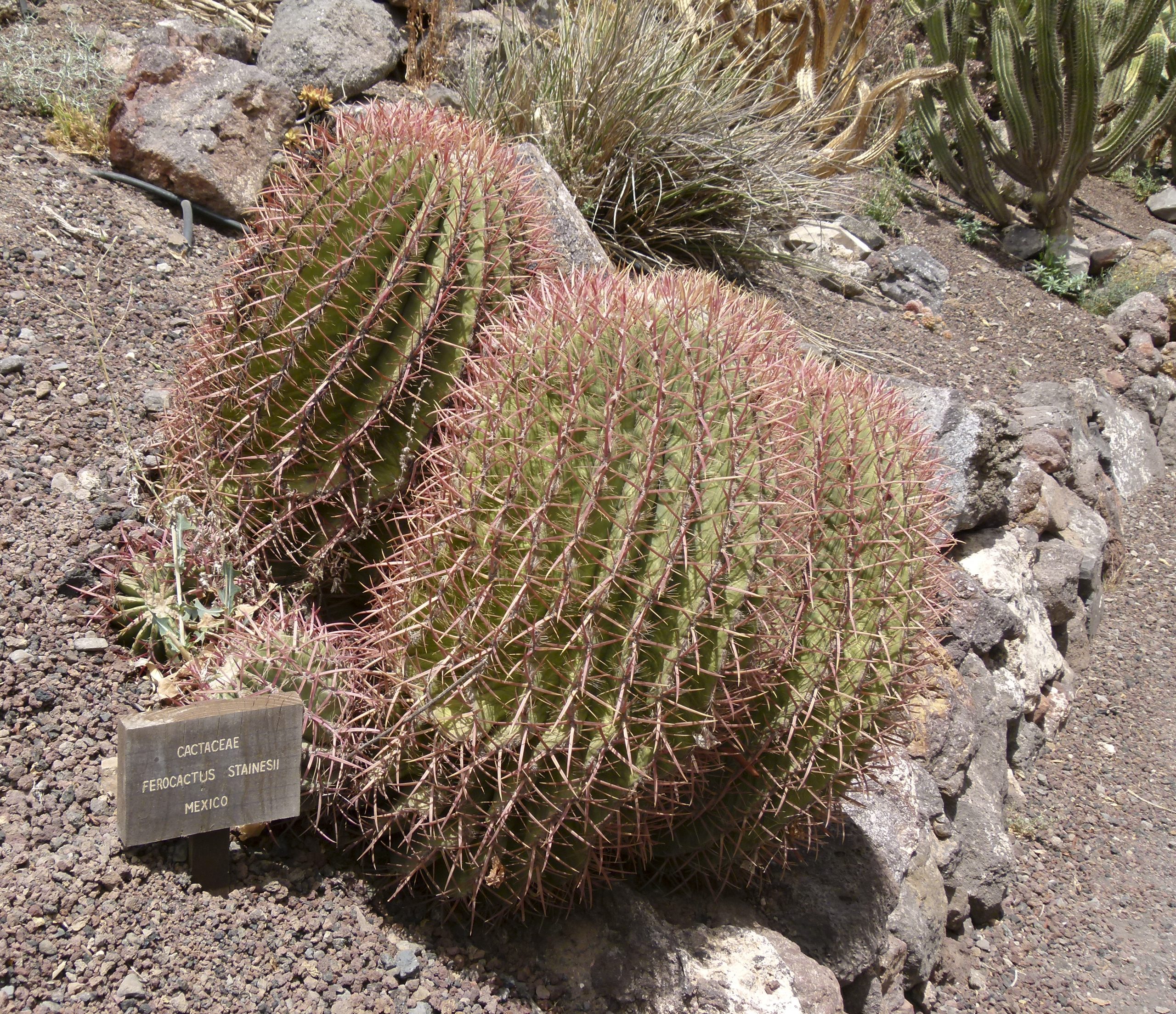
Image - Wikimedia / Norbert Nagel
This is a type of globular cactus (though it becomes somewhat columnar with age) native to Mexico, specifically found at altitudes between 1000 and 2400 meters above sea level, on hillsides and plains. It is popularly known as the barrel cactus and can reach a height of 3 meters and a thickness of about 40-60 centimeters . Its stem is composed of 13 to 20 ribs. It has long spines, up to 4 centimeters in length, of a deep red color.
The flowers are also about 4 centimeters across , although they don't usually open fully because the thorns prevent them from doing so. They are yellow or red. The fruit is ovoid, yellow, and contains numerous small, black or light brown seeds.
Ferocactus stainesii is a species vulnerable to extinction , which is why it is included in the Convention on International Trade in Endangered Species of Wild Fauna and Flora or CITES (Appendix II), and in the IUCN Red List (International Union for Conservation of Nature).
What are the care that must be given?
Regardless, this is a fairly commercialized cactus. And it grows fast, but it also multiplies well by seed. In addition, it does not require special care. However, to keep it in good condition it is important to take into account its basic needs:
Climate
The barrel cactus is a succulent that lives in the semi-arid regions of Mexico , where temperatures can reach up to 40 degrees Celsius and where occasional light frosts occur. It also thrives in sunny areas.
Location
When you acquire your specimen, it is necessary to check where it was in the nursery : if it was in full sun, you can put it in a sunny place as soon as you go to your garden or patio; otherwise, the ideal thing will be to have it in a bright area but protected from the sun.
In the latter case, in addition, you will have to accustom it very little by little and gradually to direct sunlight.
Soil or substrate
- Flower pot- Generally a good standard mix is as follows: 50% black peat + 50% perlite. But if the humidity in your area is very high, I recommend having it in the cheek, since this reduces the risk of its roots rotting.
- Garden: the soil must be light, porous, limestone and must have good drainage.
Irrigation
It's a drought-tolerant plant, but only to a certain extent. If it's a young, potted plant, it will need watering about twice a week during the hot, dry months. In contrast, a mature, acclimatized plant in the garden will only require occasional watering throughout the year.
Anyway, every time you water it, you have to wet the soil, not the plant. If it is in a pot, it must have holes in its base so that the water can escape.
Subscriber
-

- Image - Wikimedia / H. Zell

-

- Image - Wikimedia / rosier
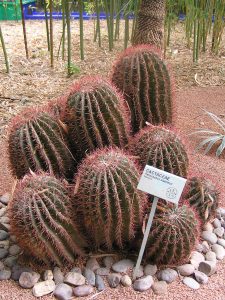
From early spring to late summer, you can fertilize your Ferocactus stainesii with a cactus fertilizer. However, follow the instructions on the product packaging, otherwise you could apply more than necessary. If this happens, the roots will be damaged, and the plant will begin to look unhealthy.
Multiplication
It is propagated by seeds in spring-summer . It is best to sow them as soon as they are ready (mid/late summer) as this is when the probability of germination is highest.
To sow them, you have to fill a tray with some small holes in the base with universal substrate mixed with perlite in equal parts, or vermiculite. Place the seeds on the surface, and spread a very thin layer of substrate on top.
Then, you have to place a plate under the tray, and fill it with water so that the earth is moistened. Do it again every time you see that it is dry.
Finally, place the tray outside, in a sunny area. In this way, they will germinate in about 15 days.
Transplant
It is a cactus that, if we take into account its characteristics, must be planted in the ground as soon as possible. While it is a small 'ball' of up to 20 centimeters, it can be kept in a pot, but then the transplant begins to be dangerous.
The best time to plant it in the ground is spring , when the risk of frost has passed.
Rusticity
Ferocactus stainesii can withstand temperatures down to -3ºC.
Do you have any in the collection?
Table of Contents