

Image - Wikimedia / Brian Gratwicke
Gasteria are non-cactus succulents that, while not as popular as some others, are very beautiful, hardy, and easy to care for , making them a must-have in any collection. They can even be planted in gardens, in those spots that don't receive direct sunlight.
Want to know how to care for them? Well, below I'll explain everything you need to know if you want to get one and make it last for several years.
Origin and characteristics
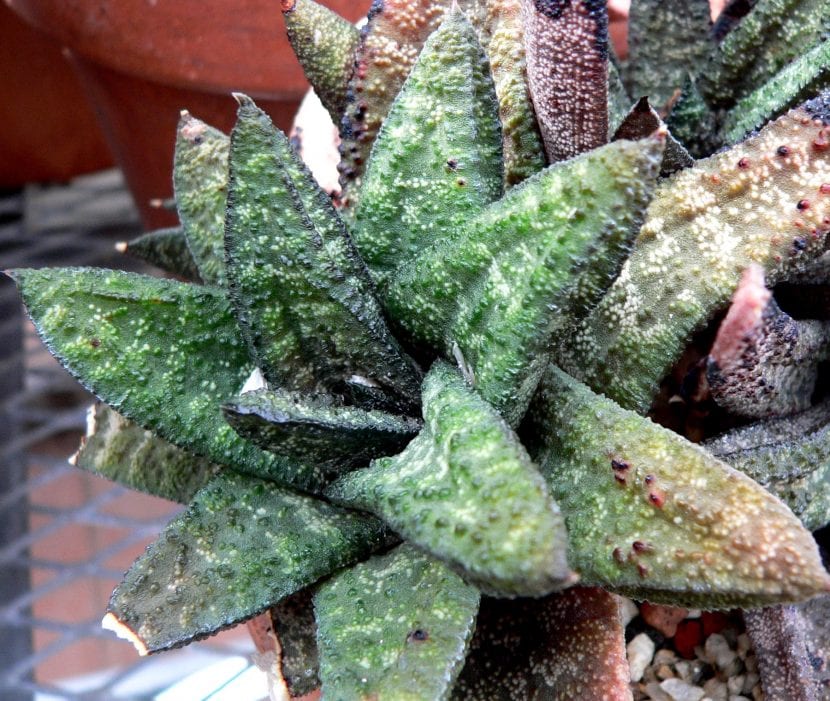
Image – Stan Shebs // Gasteria batesiana
Our protagonist is a genus of non-cactus succulent plants native to South Africa. They are related to both Aloe and Haworthia, and in fact, they often hybridize with each other. They produce fleshy, leathery, lanceolate leaves that are green, greenish-white, or variegated, often with white spots . In spring and summer, the flowers bloom in clusters of pink or pinkish-orange spike-like inflorescences.
They do not exceed 40 centimeters, but as they tend to take suckers from the roots, they can occupy a pots of about 20 cm in diameter in a matter of 3-4 years.
Main species of Gasteria
The most popular are:
Gasteria amstrongii (now it's called Gasteria nitida var. amstrongii)
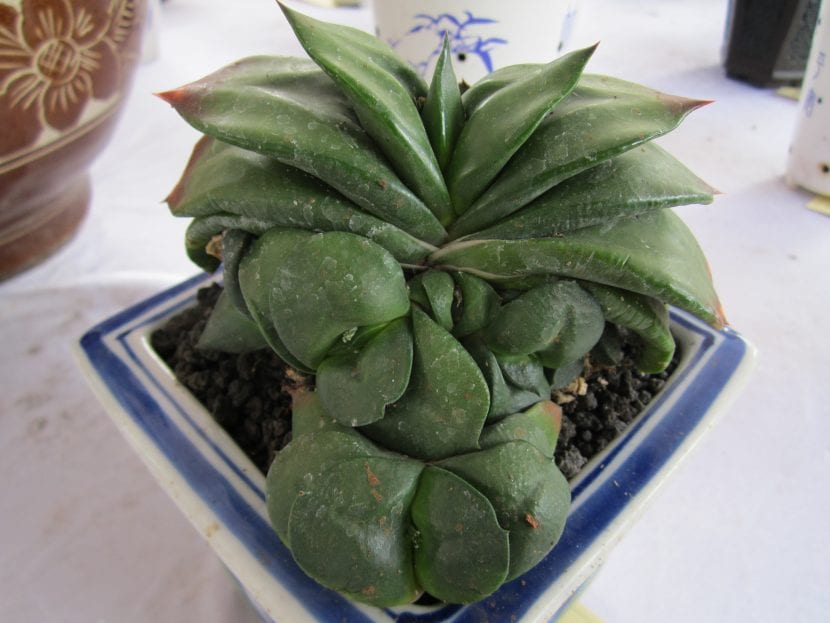
Image - Wikimedia / 22Kartika
It is a small succulent plant, 6 to 20 centimeters tall, that develops green leaves.
gasteria carinata
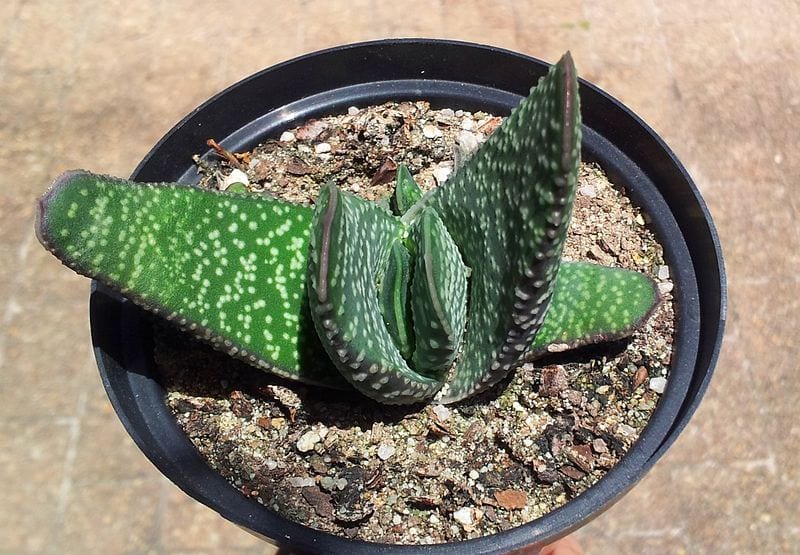
Image - Wikimedia / Abu Shawka
It is a succulent plant between 20 and 40 centimeters tall, characterized by producing green leaves with numerous white dots.
Verrucosa gasteria (now it's called Gasteria carinata var. verrucous)

Image - Wikimedia / Hippocampus
It is a small plant, 3 to 7 centimeters tall, that develops dull green leaves with numerous white spots.
How do you care for the Gasteria?
Do you want to have a copy? If so, we recommend taking care of it as follows:
Location
- Exterior: these are plants that, whenever possible, should be outside the homes, in a bright corner but without direct sun.
- Interior: in the case that you do not have a balcony, patio, or garden, they can be grown in rooms that get a lot of sunlight. But beware, they should never be placed right in front of the window since otherwise they would burn due to the so-called magnifying glass effect.
Irrigation
Rather infrequent watering . The substrate or soil should be allowed to dry out between waterings. During autumn and winter, depending on the climate, watering once a month or every month and a half may be sufficient.
Never wet the leaves, and it is also not good to make them thirsty to the point that the leaves become "wrinkled."
Earth

Image – Flickr/Reggie1 // Gasteria glomerata
- Flower pot: although they live well in mobs or in universal substrate, the ideal is to have them in volcanic sands such as the pomx (for sale here).
- Garden: they grow in sandy-type soils, with excellent drainage. If yours isn't, don't worry: make a hole big enough for a block of those holes to remain, insert the block, and then cover its sides with shading mesh. Finally, you will only have to fill it with pumice.

Subscriber
Besides water, plants need 'food' to stay healthy. For this reason, it is highly recommended to fertilize Gasteria with a fertilizer specifically formulated for cacti and other succulents (available here ), from early spring until late summer , following the instructions on the packaging.
In the case of living in an area without frost or in a mild climate (with minimum temperatures of up to -2ºC), you can also pay in autumn.
Pruning
They do not need it, but it is advisable to remove the dry leaves and wilted flowers.
Gasteria Multiplication

Image - Wikimedia / David J. Stang
They multiply by seed and by separating offshoots in spring and summer . How to proceed in each case? Let's see:
Seeds
To multiply them by seeds you have to sow them, for example, in seed trays (for sale here ) or conventional pots with holes (for sale here ) filled with vermiculite (for sale here ) previously moistened with water.
Keeping the seedbed outside, in semi-shade, they will germinate in about 10 days.
Young
It is the easiest and fastest way to get new specimens, since you simply have to separate them from the mother plant when they are about 2-5cm tall, let the wound dry in semi-shade for about five days, and finally plant them in pots -individual or not- with apices placed in semi-shade.
Thus, and keeping the substrate always slightly damp, they will emit their own roots in about two weeks.
Planting or transplanting time
In spring . Repot every 3 or 4 years. Ideally, they should be kept in trays that are wider than they are tall.
Plagues and diseases
They are very resistant, but unfortunately against mollusks (snails and slugs) they need us to lend them a hand with anti-snail remedies.
Rusticity
They withstand the cold but not severe frosts . Cultivating them outdoors year-round is only recommended if the minimum temperature is -2ºC, and only for short periods.

Image - Flickr / Reggie1
What do you think of Gasteria? Do you have one or do you want to have one?
Table of Contents