

Haworthia retusa var multilineata // Flickr/salchuiwt
Haworthia retusa is a compact, non-cactus succulent that produces flowers which, although small, are quite striking as they emerge from stems much taller than the plant itself.
It is interesting to grow it in a pot, especially if it is wider than it is deep. Having a great tendency to produce suckers, it is only a matter of time before you can get new specimens of your plant at zero cost.
Origin and characteristics of Haworthia retusa

This is a perennial succulent plant native to South Africa that reaches a height of about 3-4 centimeters and a diameter of 4-5 centimeters . It forms rosettes of leathery, deltoid, recurved leaves, 1-4 centimeters long by 2 centimeters wide, pale green in color, with lines on the upper surface. The flowers emerge from a single stem up to 12 centimeters long, are white, and measure about 1 centimeter in diameter.
The growth rate of Haworthia retusa is quite fast, but it should be noted that once adult it is small, so it should not surprise us that, after a few years, it only spends energy flowering and producing offshoots.
What are the care that must be provided?
Haworthias, in general, are very easy plants to care for. They are very drought-resistant, and unlike most succulents, they thrive in areas where they don't receive direct sunlight . For this reason, they could be a good option for growing indoors, although they do best outdoors. In fact, no plant is truly an indoor plant, since when humans began to evolve, the plant kingdom was millions of years ahead of us.
In addition, the decoration of the houses with plants is even more recent. It is not known with exactitude, but surely it began during the reign of the pharaohs, in the year 1500 a. C.
But let's not get sidetracked. How do you care for a Haworthia retusa ? If you decide to get one, we recommend providing the following care so you can enjoy it both indoors and outdoors:
Location
- Exterior: it must be in a protected area of the star king.
- Interior: the room in which it is placed must be bright, that is, it must be very bright.
Irrigation

Image - Flickr / salchuiwt
Watering should be minimal . It's a drought-tolerant plant, but excessive moisture is very harmful, to the point that you could lose it due to root rot.
To avoid problems, it's best to water only when the soil is completely dry . This means you'll need to moisten it again roughly once or twice a week during the summer, and every 10 to 15 days the rest of the year.
During the winter water once a month if there is frost and / or if it rains frequently. And if you have it in a pot, do not put a plate under it since stagnant water would cause damage to the root system.
Earth
- Flower pot: fill with universal substrate mixed with perlite in equal parts, or with mineral substrate such as pumice.
- Garden: the land must have excellent drainage. If it does not have it, make a hole of about 40 x 40 centimeters, and fill it with pumice or quartz sand.
Subscriber
Besides water, your Haworthia retusa will appreciate occasional fertilization from early spring to late summer . For this, we recommend using a fertilizer specifically formulated for succulents, like the one sold here . However, it's important to follow the instructions on the packaging to avoid over-fertilizing.
Multiplication
It multiplies by seeds and offshoots from spring to summer , following these steps:
Seeds
- First, a wider than deep pot has to be filled with soil for cacti and succulents.
- Then, it is watered thoroughly.
- Finally, the seeds are spread on the surface of the substrate, ensuring that they are separated from each other, and are covered a little with quartz sand (for sale here).
Keeping the seedbed watered, they will germinate in about 5-15 days.
Young
The pups can be separated from the mother plant when they reach about 2 centimeters in size . If done earlier, they may not be viable. This is because, being such a compact plant, it's somewhat difficult to separate the pups from the mother. In fact, the best approach is to remove the plant from its pot and carefully separate the pups, ensuring they have some roots attached.
Afterwards, they are planted in individual pots (or in groups ) and watered.
Planting or transplanting time
In spring , when the minimum temperature is 15 degrees Celsius or higher.
Rusticity
Haworthia retusa can withstand cold and frost down to -2ºC , but it is advisable that it does not go below 0 degrees.
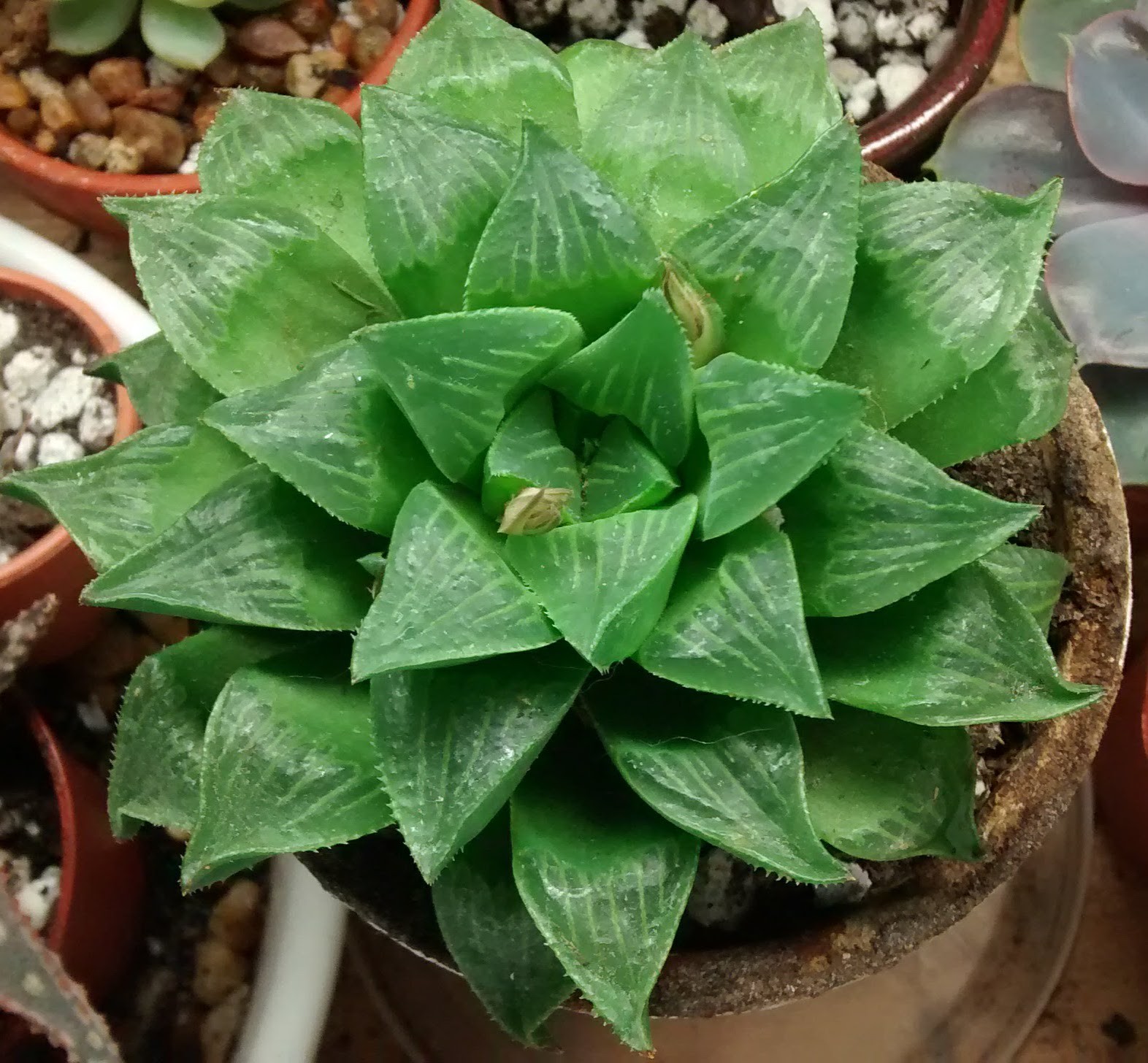
Image - Flickr / Jeff Oien
What did you think of this plant? Did you know her?
Table of Contents