

Lithops weberi
Lithops are by far one of the best-known succulent plants in the world. They don't have leaves like other plants; instead, as they evolved, they have transformed into what many people call "buds," from the center of which emerges a beautiful yellow or white flower.
Its growth is slow, which, combined with its small size, makes it not just a suitable succulent, but perfect to keep in a pot throughout its life.
Lithops is a genus of succulent plants belonging to the botanical family Aizoaceae, native to Southern Africa, described by Nicholas Edward Brown and published in The Gardeners' Chronicle in 1922. To date, a total of 109 species have been accepted, the following being some of the most popular :
Lithops lesliei

Lithops optic

Lithops salicola
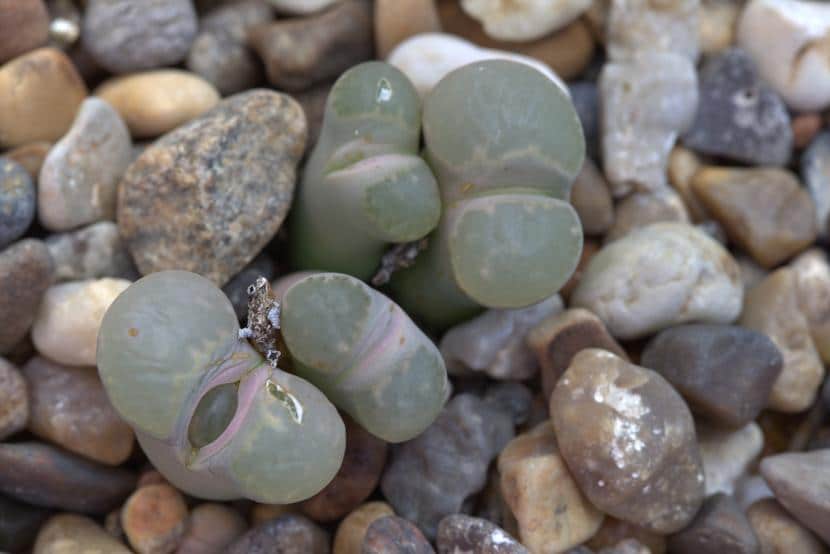
Due to their kinship, they are commonly known as living stones or stone plants. But what makes these plants so special? Well, Lithops are known as "window plants." What does this mean? Unlike other plants, the surface of their leaves has small transparent or translucent areas without chlorophyll through which sunlight passes, reaching the interior of each leaf where the succulent can perform photosynthesis ; that is, convert the sun's energy into starch and sugars to feed itself and stay alive.
Their beautiful flowers are very reminiscent of daisies, but much smaller, barely 1 centimeter in diameter. Depending on the species, they may bloom in late summer or autumn , but you can admire and enjoy them every year .

Lithops aucampiae
Lithops are very easy to grow, requiring only bright light, a well-draining, porous substrate —such as pumice— and infrequent watering (generally twice a week in summer and every two weeks the rest of the year). To prevent problems, allow the substrate to dry out completely before watering again, and avoid placing a saucer underneath to prevent root rot. Additionally, from spring to summer, fertilize with Nitrofoska Blue, adding a small spoonful every two weeks, or with liquid fertilizers for cacti and succulents following the instructions on the packaging.
During the rainy season, or if you live in a humid area, you should protect your plants from snails and slugs , either with granular molluscicides or natural remedies like beer or diatomaceous earth. Other options include simply catching them and moving them at least 600 meters away, or using mosquito netting as if it were a greenhouse.
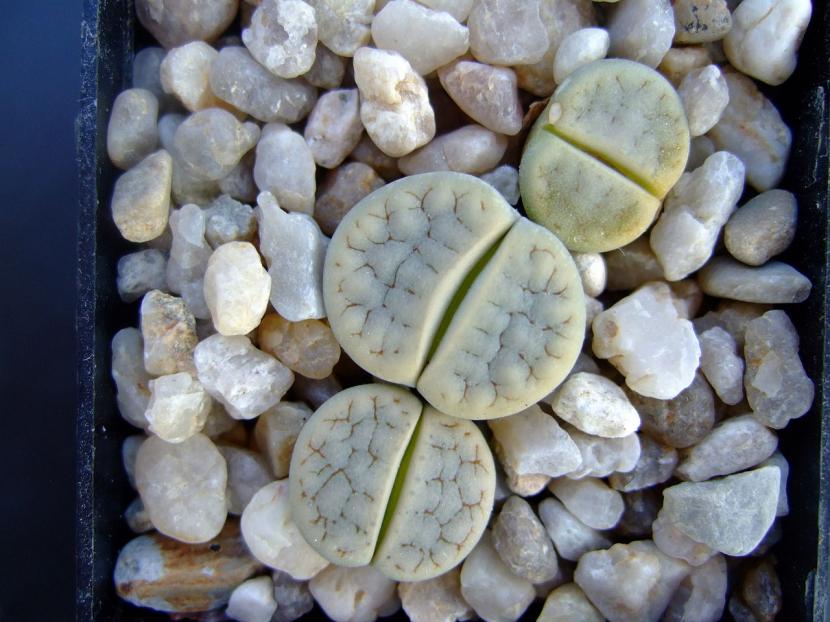
Lithops gracililineata subsp. brandbergensis
Furthermore, it does not need transplanting as long as it is fertilized, and it can be grown outdoors all year round if the temperature does not drop below -2ºC.