

Have you ever seen a non-cactus succulent so compact and round? Its scientific name is Euphorbia obesa , and it's one of the most popular among collectors and enthusiasts of these plants that drive us so crazy.
They're so easy to care for and so small that it's impossible not to get one as soon as you see it. But, besides all that, there's still so much for you to discover …
Euphorbia obesa is the scientific name of a plant endemic to South Africa, specifically the Cape Province, and belonging to the Euphorbiaceae family. It was described by Joseph Dalton Hooker and published in the Botanical Magazine in 1903.
It has a rounded shape, with a diameter of about 6 cm when young and up to 15 cm when mature, and a maximum height of 30 cm . It displays a total of eight ribs adorned with small, light-colored protuberances. While green, areas of red and purple can be seen when exposed to sunlight. Like all Euphorbias, it contains toxic latex.
It produces flowers during the summer , but they are not of great ornamental value as they are very small and almost insignificant. These sprout from the apex of the plant—the center.
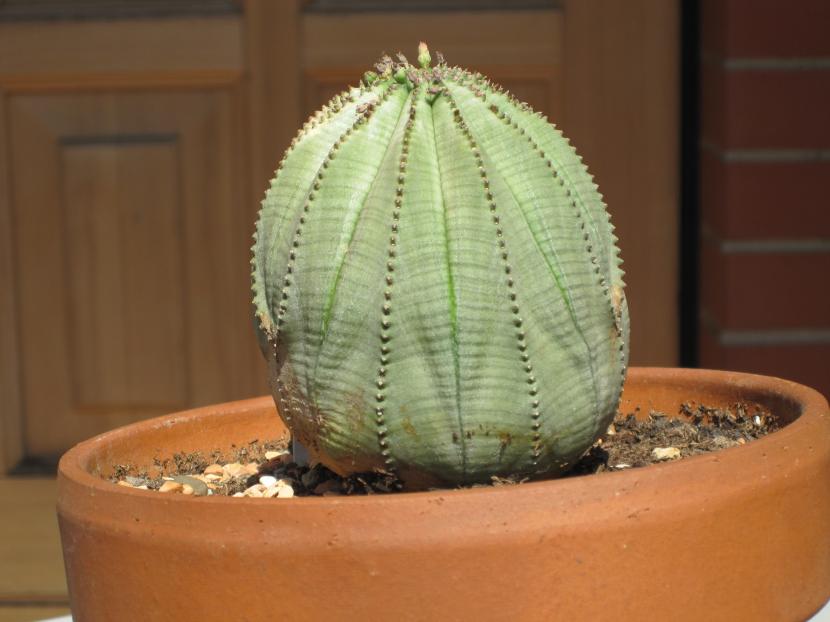
It has a fairly slow growth rate, so I strongly advise against planting it in the ground . It's best to keep it in a pot and enjoy it day after day, carefully monitoring its watering, which should be very infrequent, and above all protecting it from mollusks (snails and slugs) with mosquito netting, beer, or diatomaceous earth.
Yes, with just this and by fertilizing it with cactus and succulent fertilizer during spring and summer, following the instructions on the packaging, you can have a Euphorbia obesa for years. It also withstands cold and frosts down to -2ºC ; however, you must protect it from hail.