

Image - Wikimedia / Frank Vincentz
Opuntia dillenii is one of the cactus species with the longest and sharpest spines. It is also quite drought-resistant, able to survive for weeks with virtually no water.
But the problem is that it's very invasive , just like the prickly pear cactus . It multiplies quickly from cuttings, and because it has very long, sharp spines, it has almost no competition.
Origin and characteristics of Opuntia dillenii
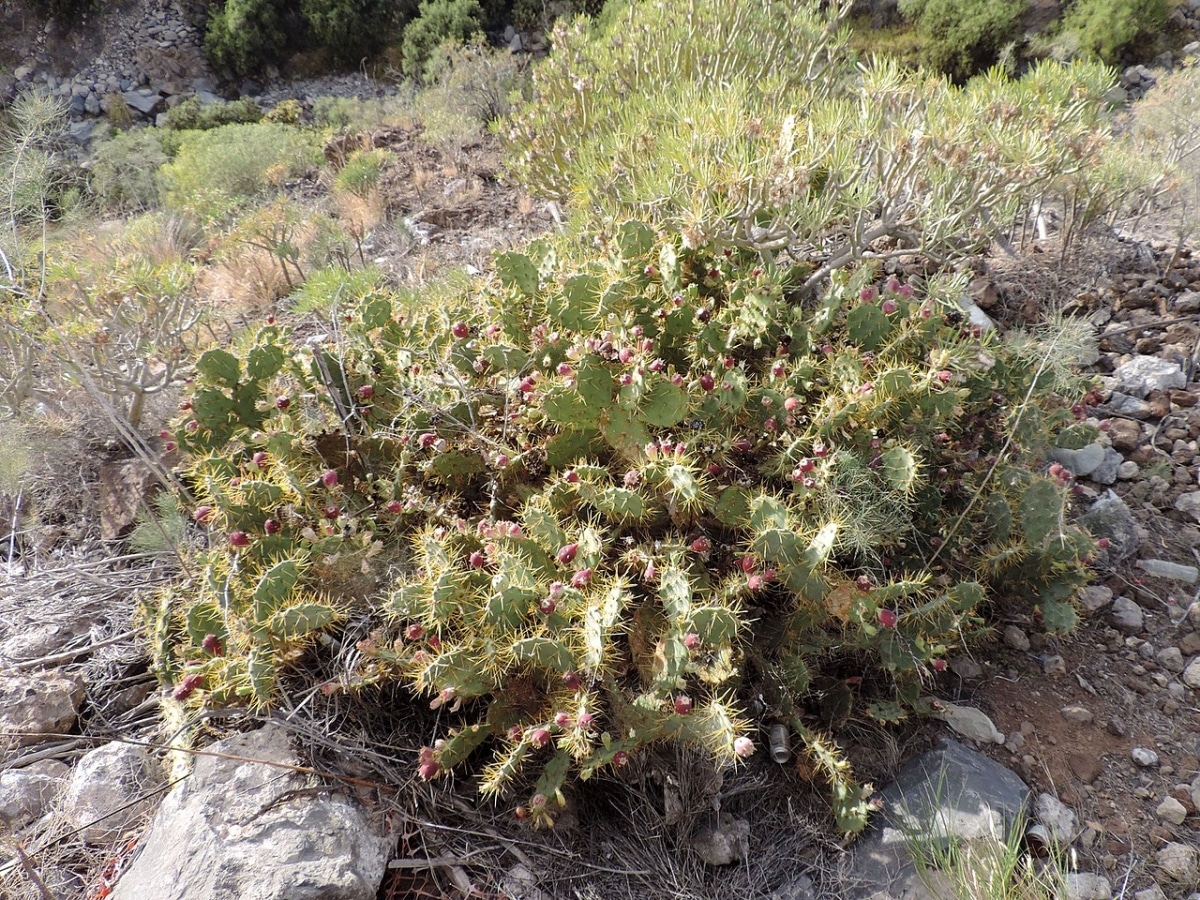
Image - Wikimedia / Krzysztof Ziarnek, Kenraiz
The prickly pear cactus, as it is known in the Canary Islands, is a species native to Central America belonging to the genus Opuntia . Specifically, it grows in Mexico and on many islands of the Antilles, such as Jamaica, Cuba, Puerto Rico, and Haiti. In Spain, it is an invasive plant and, as such, was included in the Spanish Catalogue of Invasive Exotic Species, which is regulated by Royal Decree 630/2013 of August 2. Therefore, in Spain, its possession, trade, and trafficking are prohibited, as is its introduction into the natural environment, since it poses a serious threat to native flora.
Focusing on its characteristics, we're talking about a species that reaches a maximum height of about 2-3 meters, and roughly the same width . Its leaves, commonly called fronds or cladodes in botanical terms, are actually flattened branches that perform the same functions as normal leaves, such as photosynthesis. For this reason, they are green, as they contain chlorophyll.
Glochidia sometimes emerge from their areoles, which are leaf spines that in the case of this species are yellow in color. These appear in number from 1 to 5, and measure up to 5 centimeters in length. You have to be very careful with them, as a simple rub is enough to make them stick to clothing or become embedded in the skin.
The flowers are yellow, sometimes with orange or reddish tones , and measure between 7 and 8 centimeters long. They are spherical in shape and lack spines. The fruits are pinkish-red and edible.
What to do if we see it in nature?
First of all, it's important to remember its place of origin: if you're not in America, for example, if you see it in Spain, then it's a cactus that is invading, or has already invaded, an ecosystem, so the best reaction we can have is to notify the Environment Officer of the autonomous community so that they can take the necessary measures.
If we see it in a garden, whether public or private, the first thing to do is to make sure that it is an Opuntia dillenii , and to do this you can look for images on the Internet and, above all, consult the characteristics to check that the plant we have in front of us corresponds to the species we suspect it is; or talk to the person in charge.
Can you cultivate Opuntia dillenii outside of Spain?

Image - Wikimedia / Santamarcanda
In Spain, as we mentioned, its cultivation is completely prohibited. But if you're in another country, the most important thing to do is check if it's included in the list of invasive species , because if it is, possession might not be allowed.
However, if selling it is legal, we recommend keeping it in a pot so you can control its growth and prevent it from taking over the garden. Place it in a sunny spot with well-draining soil and water it only a few times a week—no more than twice.
You don't need to worry about pests or diseases , as it's very rare for it to have them. You might see a few mealybugs, but nothing serious. In any case, you can remove them with water and a little mild soap.
However, you should keep in mind that it doesn't tolerate frost . It can only withstand temperatures down to -1ºC and only if they are brief. Therefore, if temperatures in your area drop lower, you will need to protect your Opuntia dillenii.
Table of Contents