

Opuntia microdasys is one of the few species in the genus that, in addition to being suitable for relatively small gardens, can be grown in pots for many years. And that's not to mention that it's one of the easiest cacti to care for.
It's no surprise, then, that we find it in any nursery, garden center, or local market. But what makes it so special?

Opuntia microdasys var. albispine
Opuntia microdasys is the scientific name of a cactus native to central and northern Mexico . The species was described by Johann Georg Christian Lehmann and published in Enumeratio Diagnostica Cactearum in 1837. It is popularly known as Angel's Wings, Rabbit's Ears, Blinding Prickly Pear, and Blinding Prickly Pear.
This is a highly branched plant that forms very dense clumps up to 1 meter tall . The segments (leaves) are 8 to 15 cm long, oval or oblong-oval, and green. It has large areoles from which dense glochids (very thin, usually short, leaf spines) emerge, which are yellow or brown. The flowers are yellow and about 4 cm across. It blooms in summer. The fruits are small, dark red.
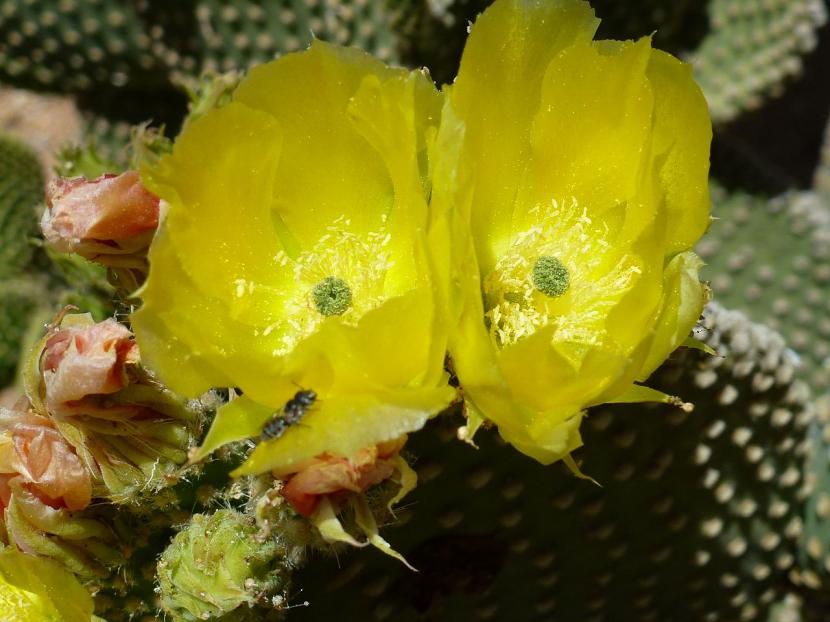
Its cultivation is, as we anticipated, very simple. The only thing to keep in mind are three things:
- It must be placed in full sun. Although it grows well in semi-shade, the ideal is to gradually accustom it to direct exposure of the sun king starting in autumn if it comes from a greenhouse.
- Irrigation has to be rather scarce. No more than one and two irrigations per week.
- Thorns are very treacherousWhy do I say this? Because it is enough to touch it for a few glochidia to get stuck in the skin. So be careful.
Otherwise, it withstands the cold well, but frost is harmful . From experience, I can tell you that it can tolerate temperatures down to -1ºC if the soil is dry, but it's not advisable to leave it outdoors if the temperature drops below 0 degrees.