

Pereskia grandifolia
Have you ever wondered about the origin of cacti and other succulents? You probably have, right? These plants are very different from those that inhabit the forests and fields of planet Earth. Although, it must be said, the conditions in which they have had to live are also unique.
The evolutionary paths have certainly been fascinating. So don't miss this article so you can feel even more amazed when you see your collection.
What is the origin of cacti?
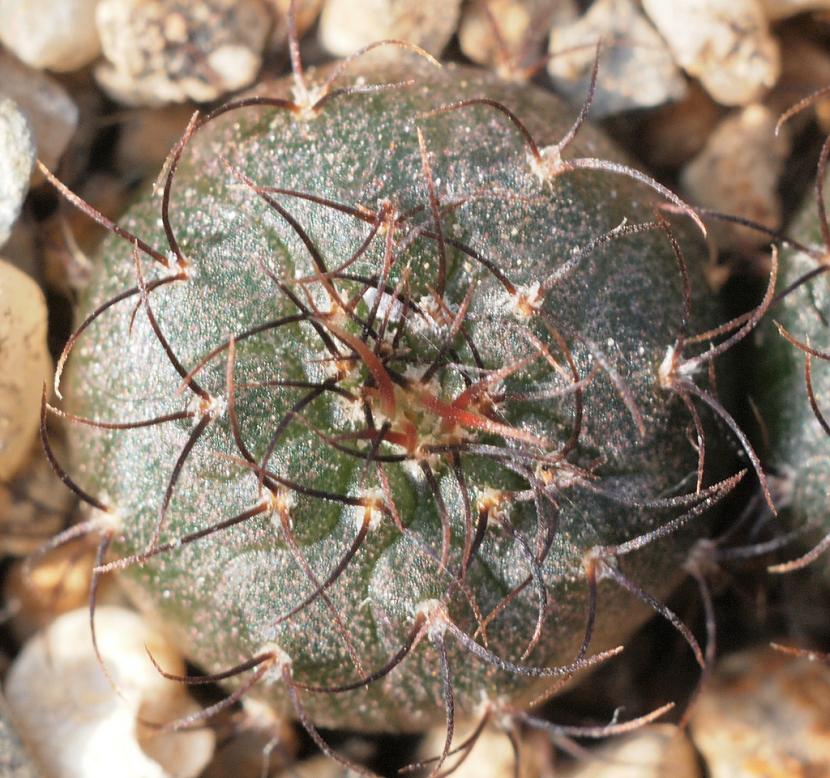
frailea asterioids
Cacti are succulent plants that have managed to conquer the hearts and lives of more than one person. They are so popular that it is hard to believe that many species have such a low price, something that only fuels our curiosity and desire to have more specimens.
To investigate their origin, we have to go back between 80 and 60 million years , to the Cretaceous period. At that time, they were conventional plants, with simple leaves arranged in a spiral pattern, with a stem that possessed wood (secondary xylem), pollen, and seeds. They lived in what is now South America, but which was once part of Pangaea.
Pangaea was a supercontinent in the process of breaking apart due to the movement of tectonic plates (the "puzzle pieces" that make up planet Earth), and it enjoyed a warm climate . As earthquakes and volcanic eruptions divided it, each of the continents we know today drifted to their current locations.
This caused a significant change in both the fauna and flora. In the case of those primitive cacti, finding themselves in an area where it rained less and less and the sun's rays fell more directly, their bodies evolved to adapt . Some began to grow in a globular shape, remaining close to ground level, while others grew taller.
But the most dramatic change was the replacement of the leaves with spines , which are actually foliar spines (hence, for example, when we accidentally pull one off, another one sprouts after a while). They could no longer photosynthesize through them, but that wasn't a problem: the stem began producing chlorophyll , and as a result, it turned green.
To date, over 200 genera of cacti are known, comprising some 2500 species . They certainly haven't done too badly for themselves.
What is the origin of succulent plants?

Argyroderma 'Holrivier'
Succulents, or non-cactus succulents, are plants that appeared after cacti , as the landmass that is now the African continent gradually moved into its current position over millions of years. Unfortunately, it is not known exactly when succulents began their evolution.
What I can say for sure is that many succulent species , mainly belonging to the Aizoaceae family ( Lithops or Argyroderma), can be found south of the Sahara Desert , in the Horn of Africa, in places like Namibia, Botswana, Lesotho, and South Africa. However, you should know that other plants, such as Sempervivum and Aeonium, are not native to this region, but rather to the Canary Islands, the Alps, the Carpathians, the Balkans, and Turkey, among others.
Did you find this topic interesting? If you still have questions, don't leave them unanswered.