

Image - conespinas.blogspot.com
Cacti, succulents, and plants with caudexes are generally quite resistant to pests and diseases, but sometimes neglect weakens them, attracting various microorganisms, such as certain Puccinia and Melampsora, fungi that you probably know better by their common name: rust.
This fungal enemy doesn't care what type of plant it infects; in fact, it's one of the most common pests we see in gardens and, unfortunately, in collections as well. But don't worry: there's plenty you can do to keep it away from your succulents .
What is rust?
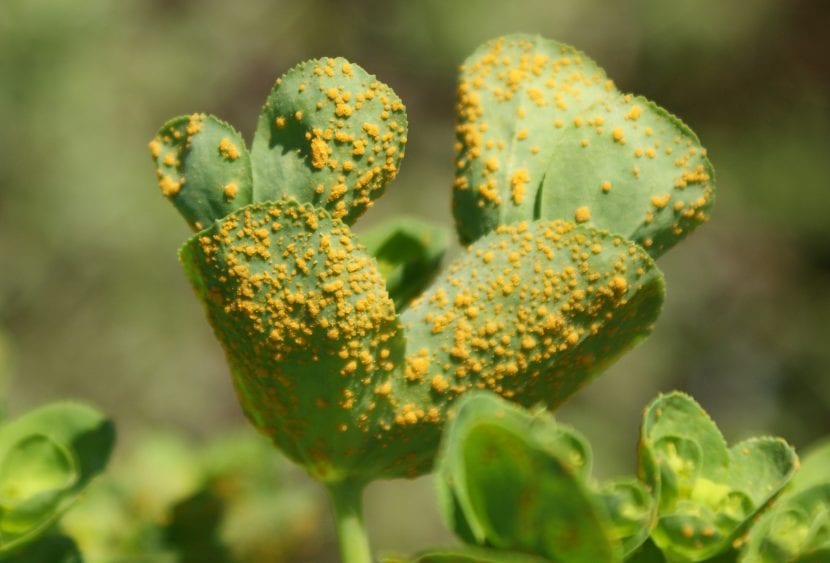
Also known as black rust, it is a disease transmitted by various fungi that live in the soil , or even in the substrate. Like all members of its family, it thrives in warm, humid environments, and is therefore much more active during spring and summer.
But still, don't let your guard down: a winter with mild temperatures and excessive watering can make any succulent sick.
What are the symptoms?
The most common symptoms are the following:
- Appearance of very small bumps and of almost rounded appearance of brown-orange or reddish color. We would see these in the body of the cactus, or in the leaves and stems of succulents and plants with caudex.
- Fall of leaves, but only if the attack is severe.
- Growth slowdown. It is difficult to see it in species that already grow slowly, such as Ariocarpus agavoides, but on the contrary, it could be noticed in others such as those of the Aeonium genus.
- Sometimes, flowering out of season. It is rare in succulents, but when a plant is very sick, it can expend all its energy in flowering to try to leave offspring.
How is it treated?
Chemical remedies
It's important to clarify that currently there is no chemical fungicide that can cure the disease . This means that the products we find in nurseries will only help control the disease to the point of reducing symptoms and allowing the plants' immune system to keep it under control; but nothing more.
They will be healthy for a while, but at the slightest sign of weakness, they will have symptoms again. If the comparison is allowed, the same thing happens with the common cold that we all have sometimes: we are healthy for a few months, but there is a drastic drop in temperatures (for example) and the only thing we have are medicines that relieve our symptoms, but they do not heal.
So, having said that, what product should you use if your succulents have rust? Well, the most advisable are those containing oxycarboxin , due to their rapid effectiveness. However, you must follow the instructions on the packaging to the letter, not apply it if the plant is exposed to sunlight (wait until sunset) or on windy days, and wear rubber gloves for protection.
Home remedies

Image - plagaswiki.com
If we prefer to use homemade or natural products, copper or sulfur powder are highly recommended . Both are highly effective natural fungicides, so much so that it's becoming increasingly easy to find products containing one or the other in nurseries, suitable for organic farming.
In any case, it is probably cheaper to buy them directly from garden stores (not nurseries), or from those that sell a little of everything.
There are two ways to use it :
- One is to spray / sprinkle the plant to be treated with water and then sprinkle the copper or sulfur over it, as if we were adding salt to a salad, avoiding excesses.
- And the other is diluting one or two tablespoons of copper or sulfur in 1l of water and spraying the plant.
In any case, you have to try to do it on days when there is no wind, and always having the specimen to be treated protected from the sun (that or, as we said before, wait for sunset).
It is also highly advisable to pour a little on the substrate and then water.
Can it be prevented?

No disease can be 100% prevented, but it is true that when it comes to succulent plants, there are some measures that, if taken, will help keep them healthy. These are:
- Water only when necessary, allowing the substrate or soil to dry between waterings.
- Do not over water, as they rot easily this way.
- In the case of having them in pots, use substrates with good drainage, which filter the water as quickly as possible. Also, you do not have to put a plate under them.
- If we are going to plant them in a rather compact soil, the ideal thing will be to make a large hole, and fill it with black peat mixed with 50% perlite for example.
- Fertilize throughout the growing season, since to be really healthy they need water but also food. We will use specific fertilizers for cacti and other succulents, or blue nitrophoska.
- You have to make sure they have the space they need to grow. In the garden, you should not plant two large species together for example; And if they are grown in a pot, you have to remember to transplant them to a larger one every 2 or 3 years.
With these tips, rust will not bother your succulents much .
Table of Contents