

There are many plants that fit perfectly into a garden or collection of cacti, succulents, and/or caudiciform plants, and undoubtedly one of the most popular is the Sansevieria . Placed in areas where the sun's rays don't reach directly, they are a marvel.
They don't require much care , and they also have a quality that has been recognized by NASA itself that cannot be ignored .
Origin and characteristics of Sansevieria
Our protagonist is a genus of herbaceous, perennial, rhizomatous plants comprising about 130 species native to Africa and Asia. They are known as snake plants, lizard's tail, mother-in-law's tongue, or Saint George's sword, and are characterized by their generally long, wide, and flat leaves , although they can also be concave or cylindrical, and are greenish, green and yellow, or grayish in color, with or without spots.
The flowers are grouped in racemes, panicles, spikes or fascicles, and are white. The fruit is an inedible berry that ripens in summer-autumn.
Main species
The best known are:
Sansevieria trifasciata

Image – Wikimedia/Mokkie // Sansevieria trifasciata 'Laurentii'
It is a plant native to western tropical Africa, extending to Nigeria and east to the Democratic Republic of Congo. Its leaves are very long, reaching up to 140 centimeters in length and 10 centimeters in width, rigid, and dark green with lighter green transverse lines.
The flowers are grouped in clusters up to 80 centimeters long, and are greenish-white. The fruit is an orange berry.
Sansevieria cylindrica
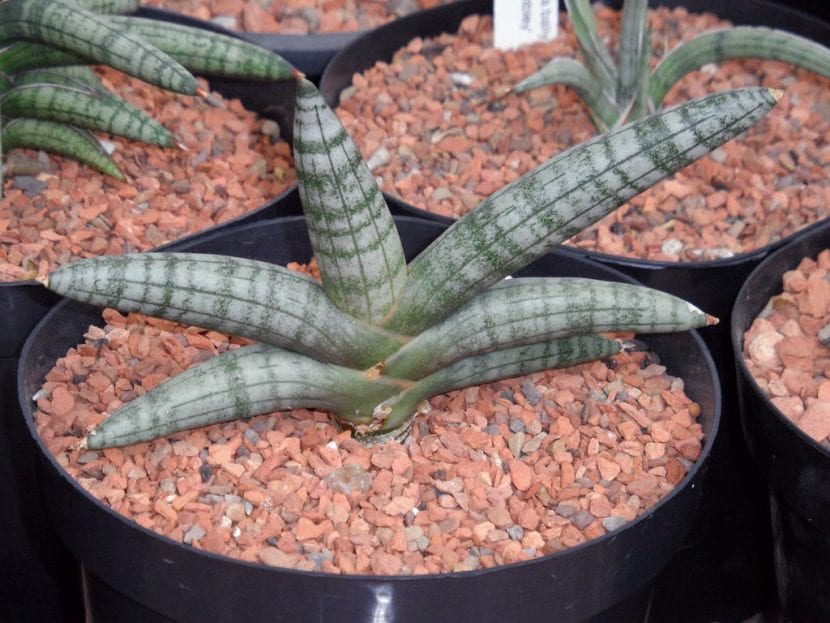
Image – Flickr/Marlon Machado // Sansevieria cylindrica var. patula 'Boncel'
It is a plant native to tropical Africa, especially Angola, which has no more than five cylindrical or slightly flattened leaves up to 2 meters long by 3 centimeters in diameter , green in color with bands of a darker green.
The white flowers emerge from a leafless flower stalk called an escape that is up to 1 meter long. The fruit is a small berry about 0,8 centimeters in diameter.
What are their cares?
If you want to have a copy, we recommend that you provide it with the following care:
Location
It will depend on where you want to have it :
- Interior: in a bright room, but without direct light.
- Exterior: in semi-shade, for example, under the shade of a tree.
Earth
Again, it depends:
- Flower pot: It is very adaptable, but will grow best in a mix of the universal growing medium style with 50% perlite. You can get the first here and the second here. Other options are the akadama (for sale here) or the pumice (for sale here).
- Garden: grows in poor soils, with very good drainage. If yours is not like this, feel free to make a planting hole of about 50 x 50 centimeters, and fill it with the mixture of substrates mentioned above.
Irrigation
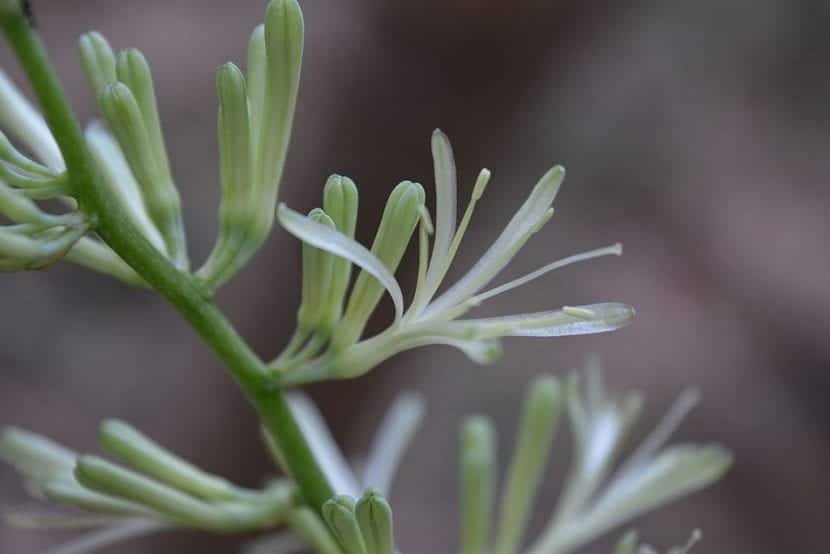
Image – Wikimedia/Vinayaraj // Flowers of Sansevieria trifasciata
This is one of the things that Sansevieria have in common with cacti, succulents, and all the other succulents we know: they require very little watering . In fact, this is one of the reasons why they wouldn't look out of place in a cactus garden, a succulent garden, or even among a group of Pachypodium lamerei, for example.
They are very sensitive to root rot caused by waterlogging, so you only need to water when the soil is completely dry. More or less, the ideal is to proceed to water it once a week in summer, and every 10-20 days the rest of the year.
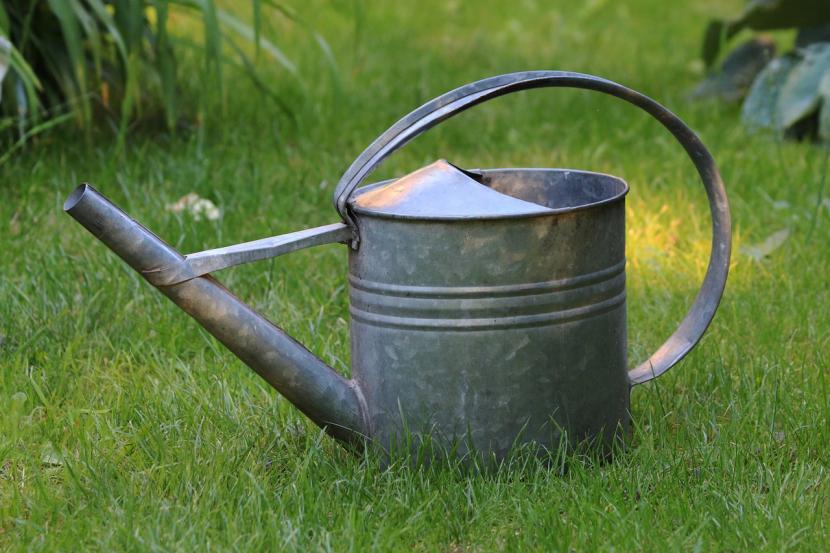
Never wet the leaves , and if you have a saucer underneath, remove any excess water 20 minutes after watering.
Subscriber
From early spring to late summer . You can use liquid succulent fertilizer you already have at home, or one you can buy here . Follow the instructions on the packaging to avoid the consequences of over-fertilizing (damaged roots, yellowing or drying leaves, stunted growth, and/or death of the plant).
Planting and / or transplanting time
In spring , when the risk of frost has passed.
Plagues and diseases
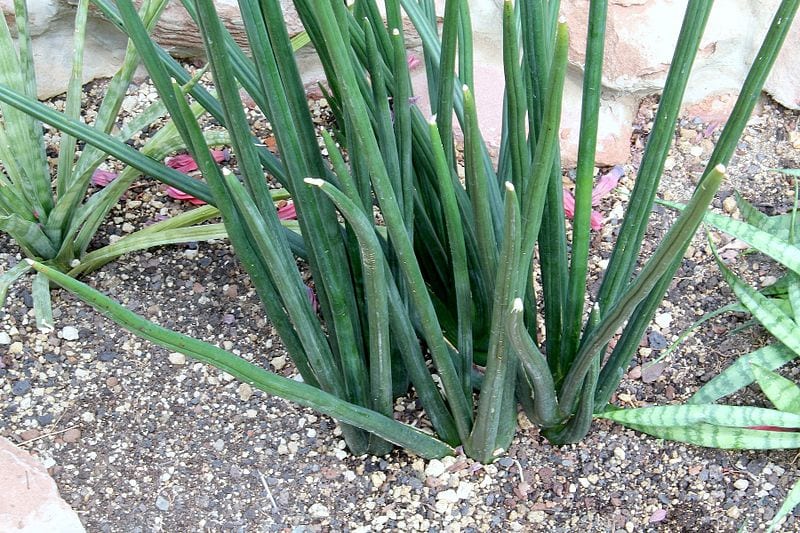
Image – Wikimedia/Peter A. Mansfeld // Sansevieria erythraeae
It's very hardy. However, mollusks (especially snails) need to be controlled during the rainy season. Fungal diseases can also occur if the plant is overwatered.
Multiplication
Sansevieria can be propagated by seed and by separating offshoots in spring and summer . Let's see how to proceed in each case:
Seeds
To multiply it by seeds, you have to fill a pot with holes with universal substrate mixed with 50% perlite, moisten them well and then put them on the surface, covering them with a little substrate.
Placing the pot near a heat source, and keeping the soil moistened, will germinate in about two to three weeks.
Young
They can be separated carefully, with the help of a small hoe if it is in the ground, or by removing the plant from the pot and cutting it with a previously disinfected knife, and then planting it in another area of the garden or in another container.
Rusticity
It's cold-resistant, but frost is bad for it . From experience, I can tell you that if the temperature drops to -2ºC briefly and only briefly, it won't be harmed, but it will suffer damage from hail.
What uses are they given?

Image – Wikimedia/Peter A. Mansfeld // Sansevieria grandis
Sansevieria plants are often used as ornamentals , but they are also excellent air purifiers . Specifically, a 1989 NASA study revealed that Sansevieria trifasciata removes benzene, xylene, and toluene, thus cleaning the air we breathe.
What do you think of these plants? You have someone?
Table of Contents